DISCOVERING
AND MAINTAINING RECOVERY FOR THE CONSUMER
(A Consumer's
perspective)
"You've got to search
for the hero inside yourself,
Search for the secrets you
hide,
Search for the hero inside
yourself,
Until you find the key to
your life"
…………..M People
By
Les Mitchell
Consumer Advisor
26 February 2001©
E-mail: lesmich50@hotmail.com
Disclaimer: The views expressed in this document are those of the author. MidCentral health has not expressed any views in respect of this document, nor has the author sought them.
Preface
Throughout history, many individuals have been able to recover from a
mental illness; often through strenuous personal efforts to transcend and
overcome inadequacies or events. Recovery is a concept that is slowly taking
shape within our society on an ever increasing scale. The concept has gained
momentum from the development of the consumer movement. The increasing
involvement of consumers in service delivery and resource development,
especially psycho-education for both their peers and clinicians, shows clearly
that a person diagnosed with a mental illness can be capable of productive and
even superior performance in socially valuable roles.
Consumer empowerment and the recovery vision have been developed in the
matrix of the Consumer Rights Movement.
My increasing frustrations, in this part of the world is the
expectations that recovery will be magically translated into reality within our
health system, made me realise that recovery belongs to the consumer. You
initiate it and an attempt should be made by a fellow consumer to map out the
recovery path and hurdles that need to be negotiated along the journey.
No model of recovery exists, per
se. I have attempted to outline a broad structure that I believe is
pertinent to each consumer; only parts of this document will accurately
describe the individual needs each consumer will have to address. Consumers,
through their own life experience and biological make-up, have an individual
road for recovery.
My own recovery has taken some thirty-five years to come to grips with.
For most of those years I was the 'French resistance' fighting the medical
model. If there is a message for our young consumers reading this, please take
the recovery concept on board now; so that by my age you will have indeed
enjoyed and have had a productive life, without sacrificing too much.
I would like to dedicate this paper to all consumers; those who have
gone before us and those who are somewhere on the Recovery Road; may your
journey be safe, fulfilling and rewarding.
CHAPTER
ONE
THE PRIMARY PHASE
I
maintain that Recovery has definable stages in its pathway. I have classified
these stages as:
¨ The Primary
Phase,
¨ The Secondary
Phase, and
¨ The Tertiary
Stage.
The
primary stage is recognising that you have an illness and accepting this. The
secondary stage is doing something about it, how to cope with it and start to
learn something about yourself; challenging possibly some of your
beliefs/actions. The final stage is the tertiary stage where you consolidate
your action plan and move onto a better life.
These
stages can be a process of going back to where you started from or progress can
be overlapping or inter-phasing.
The
three stages, I believe, allow easily identifiable targets for you with
consolidation of stages being necessary throughout the phases.
Phase 1 covers the following
tools necessary to start the Primary Phase of Recovery:
·
The awakening
·
The map of recovery
·
Satisfying the bereavement process
·
learning insight, choice and empowerment
·
developing trust and hope
·
developing communication skills
·
planning your recovery with realistic goals
·
exploring the word "holistic": mental, physical, spiritual,
social.
·
Medication education and assimilation
·
Personal responsibility
·
Positive thinking and never giving up
·
Support especially with role models
·
Diet
·
Sleep
·
Your Keyworker relationship
“THE
AWAKENING”
"You've got to search
for the hero inside yourself,
Search for the secrets you hide,
Search for the hero inside yourself
And then you'll find the key to your life."……………………………………..M
People
Recovery involves
hard work. It’s like looking at yourself in the mirror and accepting what you
see in stark reality. Sometimes what you see is what you despise; time for a
change, then?
Recovery involves
naked honesty with yourself and either acceptance, moderation or rejection of
some values. It also involves honesty with your doctor and nurse; identifying
the ‘real’ problem causing you distress. Most consumers go out of their way to
deny the problem. This in part is possibly due to lack of self-awareness or
simple naivete or in many cases part of the illness. This only extends the period
of unwellness and teaches you bad escape mechanisms. Every time we lie to
others we lie to ourselves. Lies germinate and trying to weave them into a
tapestry of deceit only fuels the introduction of extreme paranoia and
condemning guilt. Your doctor and nurse have met your problem before and
because of their position are the best ‘friends’ to help you over the rough
time of admission of human frailty. If they don’t, get a second opinion, this
is your right.
It involves
facing the basic truth as to what really triggered the ‘acute’ episode and
working on an action plan to terminate the trigger or at least know how to
avoid it in future.
My main aim in
addressing the Recovery model in the Primary stage (possibly the acute
setting), is to educate you who are new to the system, to stop the ‘revolving
door’ admission eventuality and to launch you into the secondary phase of
recovery, whilst back out in the community.
Our starting
point for recovery in life is never our own choice. Things just got out of hand.
Everything came to a boiling point inside yourself and suddenly you ended up in
hospital or at a crisis point, where your whole life disintegrates in front of
you.
For most of you waking up in hospital with someone hovering over you is
probably your first recall that you are mentally unwell. Some of us at this
stage find that we are in a stunned state unable to control our bodily
functions. For some of us we could have been kidnapped by 'aliens'. Whatever
our perception of reality and the present it is not nice. In fact is
terrifying.
It is like the first time either Mum or Dad abandoned you on your first
day of school. Horrifying wasn’t it? Having to cope with the strange antics and
customs of other traumatised kids. Everyone yelling, no one is listening to
your struggles? What made matters worse was the appearance of the
"Oldie" at the front of the class room, who reminded you of Grandma
in her dictatorial prime.
So what can we do about it? We are only consumers, what do we know?
My answer to you is that you know the whole story and each of us has
the solution it just needs a lot of discovering what we are all about and who
we want to become. Your journey through the recovery pathway will give you an
understanding of what the problem is in a way that allows you to take
responsibility for your behaviours and thereby influencing positives outcomes
for yourself.
I believe there are three mitigating causes why we ended up the way we
are:
·
Psycho-traumatising family upbringing,
·
Biological (genetic) vulnerability, or
·
A harmful psychosocial present environment possibly further worsened by
some form of addiction.
Our present environment is one that has been fashioned by us (good or
bad). Our genetic code is unique to each of us. Our families are either our
blessing or our curse. Remember these three points: environment, genetics and
family life.
The above three factors could also be linked together, adding to the
severity of your illness.
I would like to define the Recovery
Pathway as illustrated in the following diagram:
MAP OF RECOVERY
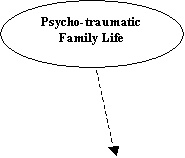
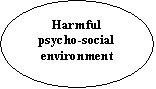
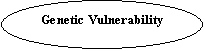

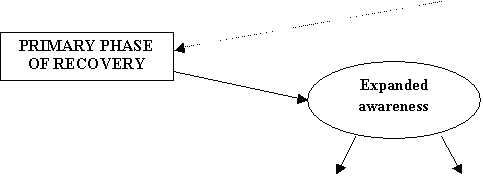
SECONDARY PHASE OF RECOVERY
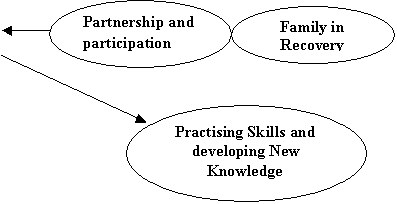
TERTIARY PHASE OF RECOVERY
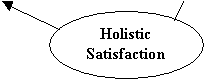
The Recovery Pathway
This pathway is a journey of self-discovery. The journey involves
looking at yourself, from your 'inner' to the external issues harming your
ability to maintain wellness. It is about learning to understand our feelings
and to work with these in balance to our 'wholeness' (oneness).
The journey is less about returning to your former glory than about discovering
whom you can become.
Remember, too, in your recovery path, you are not alone. Someone has
pioneered the trail and is keen to assist you (clinicians as well as role
models - recovered consumers). Your recovery is a long process, sometimes
taking years. It is not an instant fix.
The Primary phase is
downright painful. Identification with the illness and possible
causes can be gut wrenching - similar to the stages of bereavement.
Make sure that you go through the stages: Denial and isolation, Anger,
Bargaining, Depression and Acceptance. You will recognise this process later in the secondary phase of
recovery and perhaps during any future relapse, revisit these stages.
SATISFYING THE BEREAVEMENT
PROCESS
The primary phase involves a loss. The onset and critical part of the illness could possibly be due to the death of a loved one, loss of a job, breakdown in a relationship, financial hard times or a disaster in your social circumstances. Whatever your loss you must satisfy the grieving period and process. Cry yourself stupid if need be. You need to release your emotions and get in contact with them. Perhaps in this grieving you may want to ask for help from the chaplain. Compassion from people around you in a caring situation will enable you to pace through the bereavement until you reach the acceptance.
Denial and isolation
Your first reaction in 'awakening' is to be in a complete state of denial and you tend to 'shy' away from people, including your family and other consumers. Perhaps the shame (stigma) of it all has got too much. Learn not to feel ashamed. It is someone else's projected deficiencies, transferred to you, that you have swallowed, "hook, line and sinker"; you have been taught this negative emotion. Shame and the reasons for it affect the way you think. It is extremely negative and not good for your journey. Fight the temptation of locking yourself in your bedroom. The consumers on the ward are in the same situation you are in and perhaps the company will do you good.
Anger
Anger will surface with the frustrations you are feeling. These can be twofold:
§ Either angry with yourself or family members, or
§ Angry with the system and those running it.
Anger can be passive (words) or active (physical). Physical violence or actions in the ward are not tolerated, as much as they aren't in the community. Bad language or threatening words also is not tolerated. You will have to be responsible for any actions, which are not socially accepted. This excludes of course if the physical action is a direct result of medication or illness you are suffering, in which case you wouldn't be digesting what I have just written.
The anger is normal for you in the primary phase, whether it is with yourself or with your Professionals. You may be annoyed that no one is listening to you. Learn to consider what you are feeling may be right. You need to talk about this anger with someone you trust. It is important to consider that your anger should not affect other consumers, on the ward, who are at different stages of getting better. Take time out. Go for a stroll in the ward's gardens if you are allowed. If not, retire to your bedroom until the anger has gone.
Blame is a word you should delete from your vocabulary. It is very easy and wrong to blame others for our own predicament; although they may have added to our problems.
Bargaining
"Dear
God, if I promise that if I behave……….."
How many times have you said something similar? Not good, because we all know that bargaining basically is a one-sided affair. We do not intend keeping our part of the bargain, do we? It is part of the rich tapestry of lies we weave as consumers.
We bargain as consumers because it is an effective escape mechanism, probably from a confrontational issue (reality) with others. Don't spend too much time on this, as I will cover the reasons we fabricate further on.
Depression
The true state of things is now taking some form and we don't like it. Everyone seems to be against 'me'. Perhaps the reality of it all is sinking in and we feel alone, with a sense of hopelessness about it all. This is a good time to start crying. Cry as much as you like. It does you wonders. In most cases you will be tired and quite weak. Your nurse is the best person to seek help from. You'll reach a stage of self-exhaustion and this phase quickly passes as you witness other consumers with possibly bigger problems than you have.
Acceptance
If you have allowed yourself to walk through the former stages, and have been assisted either spiritually or by the Primary nurse, then you will reach a stage during which you are neither depressed nor angry. Acceptance is normally void of emotion as you prepare for the recovery journey before you.
Acceptance allows you to feel compassion for other consumers’ struggles. Sleep patterns will be disturbed, as short naps during the day are required to regain strength. Night sleeping medications offer relief to some consumers.
Acceptance involves the acknowledgement by yourself that it is you that have the 'key' to your life.
Having passed through this stage you have indeed opened the Recovery door; you have awakened. Socialising with fellow consumers including some very personal dialogue could be attempted, depending on the ability of being able to trust.
LEARNING
INSIGHT, CHOICE AND EMPOWERMENT
After grieving you are actually contemplating your own discharge.
This is where the phantom of the illness often visits us. Sometimes we develop a false sense of security, especially with illnesses such as schizophrenia and personality disorders. Recognising that perhaps you are vulnerable and not yet strong enough will help you slow down through talking to your nurse and fellow consumers about your feelings. You need to repair the damage just experienced. I could illustrate this by comparing it to trying to start your car on a flat battery. You need time to recharge. Time spent in getting well in an acute unit is time well invested to stop future re-admissions. You now set out on an information drive; one which will plunge you into your own reason for existence. The ability to gain insight into your predicament, your feelings and future hopes is something you learn through psycho-education, education being offered within the primary phase by group meetings in the ward and interactions with the role models (recovered consumers) and with your mental health workers. Your Primary nurse should at this stage have built up a caring relationship with you, anticipating your clinical needs and satisfying them. Your family, if you wish, also will be offering support if they are allowed to participate in your recovery. They too have their own recovery pathway to journey down.
A level of insight is achieved when you know what is wrong with you (the diagnosis). Consultations with your doctor and nurse will educate you in this regard. In some cases it is hard to diagnose, so a 'wait and see' strategy could be employed.
Some consultation meetings with professionals will be confronting and ‘not nice’ to your way of thinking. The way these talks with your doctor are held may depend on your degree of understanding (in touch with reality) at the time, your own level of insight and lastly your own degree of unwellness. Your present level of anger might not allow you to see this, however.
In all cases ask what is going on. You have a right to be fully informed. You may also like to ask what time the illness will take before you improve and what course it is likely to take (the prognosis). Understanding your diagnosis allows you a target for recovery. It allows you to be informed about the illness, what caused it, medications that are suitable for it and how you can manage it.
CHOICE
One of your rights as a mental health consumer is choice. Informed choice means that someone has to explain to you what your options are. This is particularly so in medication, as the side effects for some of us can be unbearable. Later I will highlight questions you may wish to ask your doctor about medications.
Sometimes you may have your choices controlled, especially if placed under the Mental Health Act. If you do not understand why, ask your nurse, an advocate, or you can ring the District Inspector to ask him to fully explain your rights and when a possible resolution of the situation is likely.
EMPOWERMENT
This means that you share the solutions as to how you get better through your choices and whom you should involve in your recovery plan. It also means understanding what your Consumer Rights are under the Health and Disability Act. These should be found in the ward or Service and copies given to you by your nurse on admission.
Real consumer empowerment leads to self-advocacy, which I will address in the tertiary stage of recovery.
DEVELOPING TRUST AND HOPE
Trust is a
belief, feeling and ability. People come to trust other people as a result of
relying on them, and seeing that this reliance has predictable and consistent
outcomes.
The recovery
pathway is focused on your desire to lead an active fulfilling life, valuing
clinicians who instil hope, encourage your own efforts, and provide
opportunities to pursue life goals. The trust you are seeking from clinicians
is not one that has been damaged by the parent/child relationship so often
experienced with consumers suffering compound mental disorders. Empowerment of
yourself should always be practised by any clinician.
Inability to
trust leads to unstable relationships.
In the
consultation stage, you could be very vulnerable; suspicious that trust has not
been established and could continue to put defensive (guilt?) mechanisms in the
way of the clinicians. It is important that both parties nurture a friendly and
caring relationship straight away.
Hope is a target
for the future, which basically is the responsibility of quality service
delivery of the mental health service (the way care, assessment and treatment
are handled).
Hope is a desired
and necessary aid to recovery. Without it there is no point setting up the goal
posts and trying to kick goals. Your best model of hope is the recovered
consumers employed by the hospital; either the Consumer Advisor, Consumer
Educator, or your Peer Support worker. Their resources are available to you,
normally during working hours. Remember these people are either fully
recovered, in Tertiary recovery or close to it. Their experiences are an
invaluable source of reference for you. They also show your family that
recovery is possible, thereby giving them much needed reassurance.
DEVELOPING
COMMUNICATION SKILLS
To some of us, this skill has never been truly developed, because we have never been able to address or understand our emotions. Some of us do not have trust sufficient to allow others to share in our feelings.
Forming a trusting relationship with the nurses, your keyworker and fellow consumers, allows you to discuss your feelings openly. By developing your skills in the primary phase, in a safe environment, you quickly realise that some of your fellow consumers are suffering the exact predicament you are facing. You may in fact meet some life-long friends here in the primary phase.
Listening
Most of us spend 70% of the day communicating, 45% of that time listening. We all want to be listened to. It is insulting to be ignored or neglected. Listening is more than hearing the words; it is truly understanding and having empathy with the other person. Listening reduces our irritation with others because we understand. To understand is to forgive. It also fosters more meaningful, more helpful, closer friendships.
Listening is an art. If you want to be listened to, listen. Look at the other person when you are talking and when you are listening. Listening means not talking while somebody else is speaking. Check with the speaker to ensure that you have understood their message correctly. Communication is more than just words.
Talking
It is normal that in the primary phase, you start to talk more meaningfully than ever before, perhaps because there are so many similar people around you. Don't be surprised if you start writing poetry or find hidden talents in art therapy. These are all part of your natural desires to communicate, whether passively or actively.
I will talk about self-disclosure in the next chapter but it is sufficient to understand in your progress, in the Primary stage that strong emotions (words) make some people uncomfortable; disclose slowly what you mean. For example, if you decide to openly disclose some strong feelings, people may quickly urge you to suppress your feelings. You may simply say "I'm really depressed," and the person is likely to reply "Cheer up!", or in other words, "Don't talk about it."
Body
Language
Be careful of this one. Body language is a handy message adopted by some people to either exploit the vulnerable or as a means of overcoming verbal communication problems (shy people). People who practise this generally are society's statement billboards. It is best not to wear anything gaudy or to overdo lipstick, etc.
Inappropriate body language threatens your safe environment and should be reported as soon as possible. If necessary call for assistance from a person you trust.
PLANNING
YOUR RECOVERY WITH REALISTIC GOALS:
MY TREATMENT PLAN GOALS
By now you may be feeling drained; that all of this is necessary. Learn to cope, at this stage, with what you can handle and remember take things slowly and go easy on yourself.
For recovery to be effective you need to have some form of action plan to put your ideas (realistic goals) and your partnership (the doctors, nurses and keyworker) onto a working paper for the future. This plan is called your Treatment Plan. It originates in the primary phase of recovery and accompanies you on discharge, into the community and into the Secondary Phase of recovery.
In mapping out your treatment plan (with your family if agreed), consider the following goals for yourself:
Desired
Treatment Plan Goals
ü My home life. Do I want to change this?
ü If I want to move out, where and how will I live?
ü What support will I need to cope by myself?
ü My diet. Is this a problem? When was the last time I had a complete medical including allergy testing?
ü Do I have enough physical activity to keep myself fit and well? How will I achieve this?
ü What is my job desires? How can I improve my finances?
ü Do I want further education?
ü What can I do to improve my own personal image? What can I do about my teeth? Are my fillings putting toxins into my body?
ü Can I tolerate Stress? What do I need to control this?
ü Is my relationship a problem? Can I tolerate affection?
ü Do I need to learn how to make friends and keep them?
ü What living skills do I lack and what will I need to learn for future living?
ü Do I know anything about my own spirituality? Is there a need anyway?
ü What baggage do I need to get rid of? (Things that have been a burden to me)
ü What behaviours will I change (e.g. alcohol or other social drug ingestion; anger management). Do I need help to do this?
ü Do I have problems with my sexual identity? What help do I need to support my sexuality? How will this affect my family/partner?
Whew! What a list. You may have more to add, or your family or keyworker.
Your Treatment Plan is a living document. Make sure it gets updated and that you retain an amended copy at all times.
On discharge you should have a copy of the Treatment Plan, for your referral. If you wish to amend this, especially with goal setting, make sure your keyworker knows your revisions.
One part of your Treatment Plan will be a negotiated Relapse Plan, explained as follows:
Relapse Plan
Relapse causes
suffering for everyone including the consumer, the family, and especially in
relation to the keyworker, the doctor and the nurse.
It, however, is
an opportunity to “figure it out”. Each relapse can make you feel worse and
more likely to give up. The family feels bad for you and for themselves
(Failure, guilt). Everyone’s lives are disrupted.
Leading causes of
relapse are:
1.
The illness has predictable and unpredictable changes in severity
2.
The prescribed medication is not effective enough, or is not being
taken
3.
The person is using street drugs or alcohol
4.
The level of stress has increased
5.
The level of social support has decreased
So if the above situation is
likely to occur the consumer together with the Keyworker should create the
Relapse Plan and include it into the Treatment Plan. Some of the topics you
should cover with your keyworker and family are:
Identify Patterns
¨
Be aware,
anticipate, chart or monitor, build in safety mechanisms, avoid making
important decisions, then plan “time out”
¨
List your
supporters
¨
Find the
value of hibernation or renewal
¨
Tighten or
lighten schedule
¨
Stock up on
necessities
¨
Plan
pleasurable activities for this time
¨
Identify
Triggers.
¨
Identifying
health, attitude and behaviour, environment, interpersonal and
spiritual triggers
¨
Warning
Signs/Early Intervention
¨
Coping -
especially with stress
¨
Self Management
or Alternatives
¨
Support and
Ongoing Learning
Building Wellness
¨
Getting
through tough times using anticipation and coping strategies
¨
Seeking and
accepting extra help and support
¨
Preventing
and managing crises
¨
Letting
someone else take control for a while
Crisis
Planning
With assistance from your keyworker you will need to develop a crisis plan. This should be placed on your clinical file and should be accessed by the Crisis Team in an emergency.
Things you should consider for formulation of the plan are:
1.
What does a crisis look like for you?
2.
What are the good and bad parts of a crisis for you?
3.
What helps you move through a crisis and not get “stuck”?
4.
What does support look like for you?
5.
What do you keep hidden from people when you are in a crisis?
6.
How do other people experience your crisis?
7.
Are you a person whose crisis becomes more intense in a safe
environment or is
there relief?
8.
What makes things worse for you? Why?
9.
Are there people, places, or things that have been helpful in the past?
Why?
10.
What things have you tried that are not particularly helpful?
11.
When you are in crisis do you prefer to be with people or alone?
12.
What happens when you are alone? With people?
13.
Who else is affected when you are in crisis? Family? Children? Pets?
Employer?
14.
Does connecting with these people help or hinder you when you are in
crisis?
15.
What obligations do you still have to continue when you are in crisis?
(Such as work, bills,
household, plants, kids, pets?)
16.
Do other people recognise that you’re having a hard time before you
realise it?
17.
What do you want your life to look like after crisis?
18.
Who else should be involved in developing and/or agreeing to your
crisis plan?
(Adapted from Crisis Respite Interview, Stepping Stone, Claremont, NH)
EXPLORING THE WORD "HOLISTIC"
I mentioned in Chapter One the word "holistic". The Concise
Oxford Dictionary tells us that the word means:
"the
treating of the whole person including mental and social factors rather than
just the symptoms of the illness".
It also includes the physical and spiritual part of the person as well.
Remember for mainstream consumers that ‘holistic’ covers the following
needs:
Mental J Physical J Spiritual J Social
Mental
Sufficient to say we are very immersed in this topic, so I won't labour
on this one
Physical
It goes without saying that physical exercise is good for your body,
but what some people don't realise is that it is good for your mind. No I don't
mean that weight training will suddenly turn you into an Einstein; however
study after study has found that exercising regularly improves your mood,
boosts your sense of self-esteem and even enhances the functioning of your
brain.
As with other aspects of the health connection between mind
and body, scientists are only beginning to understand why physical workouts
also provide a mental and emotional boost. Many possibilities are already
known, and new research is continually going forward. For those in search of
mental as well as physical motivation, there are 12 reasons to begin some physical
program:
1.
Doing something physical can give you a sense of exhilaration and accomplishment,
and the increased esteem that results from doing something you know is good for
you.
2.
Physical
exercise causes your body to produce endorphins, the chemicals
that dull pain and help produce what's known as the exercise "high".
3.
Weight-bearing exercise in particular raises your testosterone levels, which helps improve your mood, especially if
your levels are naturally low.
4.
According to Harvard psychiatrist John J. Ratey, M.D.,
co-author of a book on psychological disorders called Shadow Syndromes, a single workout can raise your brain's
levels of antidepressant chemicals, such as dopamine, serotonin and
norepinephrine.
5.
If
you're depressed, exercise may help, pick you up. Even getting
lost in your garden, attacking those weeds, assists in getting rid of anger,
frustration and negative thoughts.
6.
Working out hard may have even more
emotional benefits. A Duke University study found bouts of intense exercise are
very effective in reducing feelings of
depression, tension, anger and confusion.
7.
Exercising
helps you deal with stress; possibly because exercise is a form of
stress in itself and conditions your body to deal with your emotional stress.
8.
Even
a little exercise may help you feel better. Studies have
shown that any amount of exercise, from a brisk 10-minute walk to an intense
aerobics or weightlifting session, seems to decrease feelings of anxiety.
9.
Physical
exercise may make you think better. Over time, cardio exercise
(coupled with a healthy diet) improves the flow of blood that carries oxygen
and nutrients to your brain.
10.
Regular exercising was shown to improve the quality and duration of sleep. Naturally this can make
you feel less fatigued and better able to function during the day. Be careful
not to exercise 3 hours before bedtime. Your body needs time to slow down and
cool down. If you are having trouble sleeping, don't take fat-burning
supplements that contain stimulating substances such as caffeine or ephedra.
11.
Exercising
gives your mind a rest from everyday thoughts,
responsibilities and commitments.
12.
Your
body functions better after exercise. You are
fitter, healthier and less likely to suffer painful physical conditions.
Spirituality
" You are a child of
the Universe, no less than the trees and the stars;
You have a right to be here.
And whether or not it is
clear to you, no doubt the universe
Is unfolding as it
should."……………………………….. Desiderata
I have come to believe that all healing begins or ends with the healing
spirit. Even if psychiatric drugs do provide some measure of relief and
stabilisation, you can use this time they buy to look for other more permanent
solutions for recovery. This is the case for most mental illnesses: others
unfortunately will need life long medications to counter the lack of self
generating body chemicals for e.g. neurotransmitters (serotonins) in the body.
It seems to me that the most important things in life are indeed those,
which we cannot see, or physically hold. Feelings; of love, care, compassion
and faith, weave individuals and societies together and shape a sense of our
own intrinsic worth.
I have been fortunate to have met some people who seem to emanate a
profound sense of spirituality, as if it were an aura surrounding them. These
people have come from all walks of life and they all shared an ability to love
and care for others unconditionally.
The notion of spirituality lies within the heart of us and in the land
around us. It is about recognising polarities in life, certainty and loss;
beauty and pain; laughter and tears - of time passing and of a sense of
timelessness and opening up oneself to trust and love unconditionally and
treating each of these elements as part of the rich tapestry of life.
Accepting spirituality in your recovery may not always be easy - but
you will recognise it when it confronts you.
There is a need to discover the hidden meaning of the holistic
formulation necessary for one's own recovery.
Everyone should be acquainted with the notion of 'mind, body and soul'
(the holistic idea); the soul being taken from the Ancient Greek 'psyche';
hence the word psychiatry.
The application of spirituality in modern psychiatry is sadly lacking.
For example, do clinicians carry out a spiritual assessment in Crisis
Assessment? Do you often see the Chaplains as part of the Treatment team in a
ward setting? Are consumers made aware of the existence of spirituality and the
need for this for their own recovery?
Is a consumer suffering from schizophrenia actually hearing
spiritualism, or is it a manifestation of their symptoms?
The context of spirituality I talk about is your relationship with the
Universe; of non materialistic matters of your soul and your personal
relationship with a Higher Self; the intelligent non-physical side of you, that
is your prevailing mental or moral state.
In my view, the person's ability to access their own spirituality, in
depth, is proportional to the amount of baggage you were born with (genetic)
and the amount your parents burdened you with (environmental) or life's
experiences; in the formulating part of your early development in your human
journey.
The panic realisation, by yourself, that something is drastically
wrong, triggers a chain reaction of survival techniques which are often
negotiated without realising what is unfolding. To me it is apparent that a
'blueprint' exists for your own psyche's evolution and is something, which you
have no control over. I call people who have or are suffering a mental illness,
'the chosen ones'. They have been
shocked out of their social comas and are chosen to alter their holistic being
for the betterment of their own psyche.
As much as clinicians ask me which recovery model I advocate, I cannot
answer which spiritual path you should follow. Each of us has different
templates. To put 10 people suffering a mental illness into a room and expect
one recovery model to suit the lot of them is totally unrealistic. The same can
be said about the road to travel down the Spiritual Highway, this is up to you.
I warn you about the perils of the Spiritual Supermarkets available today.
Beware of tricksters, for in your present state you are indeed vulnerable. All
I can wish you is safe travel and choose wisely.
" Nurture strength of
spirit to shield you in sudden misfortune.
But do not distress yourself
with imaginings.
Many fears are born of
fatigue and loneliness,
Beyond a wholesome
discipline, be gentle with yourself"…………Desiderata
I maintain it is not recommended that you try to launch yourself,
spiritually, in the Primary Phase. Your adventure into the spiritual realm
should be commenced at a later stage in the recovery pathway; hence I have
addressed it in more depth later on.
This doe not preclude you from gaining support of your spiritual model
to help you through this primary phase (e.g. going to Church or prayers with
the Chaplain).
Social
We all like to belong. Whether we belong to a social group, a circle of
friends, a sporting team or simply just part of the family, we all have to
conform to rules. It is the way we have been taught by either our parents or
peers at school that enables or fractures us in formulating this important part
of our daily routine.
Perhaps a disaster in this area has brought on a state of unwellness.
Things could have been building up ever since adolescence. If genetic, your
illness would have had its seedlings watered in your childhood.
Today, with the virtual genocide of the extended family unit of the
1950's; where a community existed within the family unit we are exposed to a
society riddled with greed, misunderstanding, prejudice and stigma. It is not
terribly conducive for acceptance of people suffering a mental illness. Slowly
through education programmes, mental illness is becoming more accepted as the
community becomes more educated (aware). They are even seeing TV ads depicting
their football hero overcoming depression. More public figures are presenting
themselves as being victims of a mental illness; but able to recover and get on
with their lives.
Our society today has more hidden snags to it than previous generations
with alcoholism, the use of street drugs, addictions of gambling being the norm
rather than just isolated practises. It is hard to keep to the straight and
narrow. Our social environment covers, in part:
¨
Where we
live and with whom
¨
Our
community interests
¨
Our
behaviours and attitudes (beliefs)
¨
Friends (or
lack of them)
¨
Our family
ties (or lack of them)
¨
Our work
¨
Our ability
to generate income
Clinical
rehabilitation courses offered by the hospital and some non government
organisations should be able to help you in putting your social skills back on
line and to help you in getting back onto the recovery pathway.
MEDICATION EDUCATION AND
COMPLIANCE
It is important that if medication is prescribed, you are compliant
(agree to take it). However, before deciding to take it, discuss the drugs with
your doctor or nurse. The Pharmacist might also be able to help with
explanations and information sheets on the drugs. Many consumers ask me what
should they ask their doctor about drugs. I have compiled the following list,
which I think should cover all your concerns:
What
to ask your Doctor about Medication
1.
What is the name of the drug?
2.
What kind of drugs are they?
3.
How can they help me?
4.
How and when should I take them?
5.
How do I know if they work?
6.
How long do they take to ‘kick in’?
7.
How important is it that I take them?
8.
What happens if I don’t take them?
9.
What are the likely side effects?
10.
What are the published long-term effects? Will they make my teeth fall
out or decay?
11.
Are their any studies done on cancer effects of the drug?
12.
What adverse effects do they have?
13.
Can I drive after taking them?
14.
Can I drink alcohol while taking them?
15.
Can I take other medications with them?
16.
What happens if I smoke marijuana, whilst taking them?
17.
Can I take them during pregnancy?
18.
Will it affect my sex life?
19.
How long will I be on this medication?
20.
Can I have my drug treatment regularly reviewed?
21.
Can I have written/printed information about the drug and side effects?
22.
Can I take all of my medication at night if I am having problems
concentrating or even eating during the day?
PERSONAL RESPONSIBILITY
Recovery's satisfaction is a personal choice. It is your own recovery;
not the person's next door.
Whilst a member of an inpatient unit you are expected to observe the
'house rules'. Other consumers may be acting strangely around you. This is part
of their illness. It should be of no concern to you unless they are interfering
in your own personal attempts to get better.
Our problem in New Zealand is the cramped ward conditions and the
blending in the ward of many illnesses. Females, especially, could feel
vulnerable from aggressive males and females.
If you have a problem with a fellow consumer, immediately seek the help
of your primary nurse or shift supervisor or the Consumer Advocate. You are
still expected, in the ward, to abide by the social rules in the community
especially morality and personal safety issues, such as theft. It is not fair
to say I stole her purse because of my illness. You are still covered by the
judicial system as far as petty crimes are concerned.
Your own recovery is your
decision. Your attempts to get on with your own life will be applauded by the
mental health service and any help that they can give will be forthcoming.
POSITIVE THINKING; NEVER
GIVE UP
Spend time focusing on when you were well and achieving that feeling
again. Concentrate on what it is you like most about yourself. Try desperately
to negate those feelings of being worthless. This is a natural part of
depression. It may be you are hearing voices. If this happens, talk to your
nurse about what you hear and try to reason these thoughts out.
I realise it is extremely hard trying to make others understand your
feelings. You can be assured that your Primary Nurse would like to reach out
and help you. So too, will others on the ward. Feeding yourself positives helps
you reach goals. In a sporting team, how successful do you think a coach would
be if that they continually told each member of the team how badly they were
playing? You can guess the obvious outcome.
A good strategy here is to talk to positive people. For example, your
consumer representatives, employed by the hospital symbolises that recovery is
possible and works. Seek their counsel; they are only too ready to assist you.
SUPPORT ESPECIALLY WITH ROLE
MODELS
The consumer representatives I mentioned above are unique and exemplify
the workings of the recovery model within the hospital. They are a rich
resource for you, able to offer you valuable assistance in advice and advocacy
of your rights. In times of trauma you may wish to seek their help. They will
act as your advocate - someone whom you can talk to and someone you can trust.
Advocates usually work using the empowerment model, where you are
supported and encouraged to take action to resolve your concerns with the
system. Where necessary, they will act for you on your instructions.
Advocacy implies support for yourself and, where appropriate, your
family/whänau/carer to express your requirements, opinions or complaints and to
action and monitor these. This applies particularly when your rights or
interests are at risk or may have been infringed upon.
DIET
This is a very new area of research and very good books are available
on the subject. It would be remiss of me not to include it, in passing, as
necessary to maintain wellness.
The best types of foods to ingest include fresh vegetables, fresh
fruits, protein, whole grains, organic foods; anything homemade (as opposed to
packaged or processed foods).
The recent exposure of genetically modified foods in New Zealand has
seen a renewed interest in organic foods.
I have prepared a listing from Catherine Carrigan's book on Healing
Depression, exemplifying reasons to avoid drugs and chemicals in the foods you
eat if you wish to rise above depression:
|
Chemical |
Often found in |
May Cause |
|
Aspartame |
Diet drinks Children's multivitamins, Sugar Free products |
Panic attacks, visual hallucinations, mood swings, mania, headaches,
seizures, insomnia |
|
Antioxidants and Preservatives (BHA & BHT) |
Chewing Gum, candy, active dry yeast, cake mixes, enriched rice,
potato chips, margarine, vegetable oils, breakfast cereals |
Asthma, rhinitis, dizziness, confusion, cancer |
|
Monosodium Glutamate (MSG) |
Meat tenderisers, Chinese takeaways, bouillon cubes, Soy Sauce,
canned soups and gravies, beef burgers, sausages, cheese, mushrooms, tomatoes |
Numbness and palpitations, headaches, asthma, depression, mood
swings, visual disturbances, brain damage, especially in infants |
|
Saccharin |
Over the counter prescription drugs, sugar free products |
Depression, hallucinations in children, cancer |
|
Sulphites |
Baked goods, beer, wine, colas, canned food, seafood, gelatin, jams,
jellies, salad dressings, potato chips, frozen potatoes |
Asthma, fainting, low blood pressure |
Sources: Susan C. Smolinske, Handbook
of Food, Drug, and Cosmetic Excipients; and George R. Schwartz, In Bad
Taste: The MSG Syndrome.
Also you need to be aware that some spices may affect your wellness.
For example, some spices have been documented as having psychoactive
properties. e.g. nutmeg which can produce visual hallucinations, distortion of
time and space, and in some cases depression and stupor.
My advice is for you to visit your local Health Food shop and discuss
the problems at hand with the nutritionist.
SLEEP
Sleep is most important. Most people sleep eight hours a day. Sleep is
needed if we are to repair the damage done to our bodies of any recent trauma.
Sleep is a healing process. If you are
having problems sleeping, discuss this with your nurse, keyworker or doctor. I
have listed some helpful sleeping tips from the book 'Beyond Prozac' by Dr
Norden:
¨
Use the bedroom only for sleeping and sex,
¨
Set a time for going to bed and a time for rising that stays the same,
¨
Develop a relaxing bedtime routine - hot bath but allow a cool down
period,
¨
Exercise regularly (late afternoon or early evening). Allow time to
cool off (5 hours ideally),
¨
Avoid substances that alter physical or mental states - caffeine or
even cigarettes,
¨
Make your bedroom quiet and dark
-
room temperature should be cool. (A Cool head tends to promote good
sleep)
-
quiet is the rule
-
alarms should be as gentle as possible - the anticipation of a jarring
alarm works against peaceful sleep
-
waking to natural light of dawn
I have also noticed the following offers some help for consumers:
¨
In winter, allow fresh air to circulate in the bedroom. If you can
afford it, an electric blanket on the lowest most comfortable setting affords a
nice sleep,
¨
Watch that if night medication is prescribed for you it does not give
you bad side effects in the morning. For example Mogodone always makes me feel
like a stunned mullet in the morning whereas Immervane is perfect. This may
work for me but not for you. Talk this over with your nurse.
¨
The actual colour of your room and of the furnishings/bedding does make
a difference. What ever colour suits you, make sure that it is therapeutic and
assists in allowing sleep.
YOUR KEYWORKER RELATIONSHIP
Your partnership with your keyworker is the one of most important
resources available from the mental health service necessary for discovering
recovery, achieving wellness and maintaining your vision.
You will need to collaborate with your Keyworker on the following:
§
Help create your treatment plan goals, relapse plan and crisis plan
§
Available treatment options in the community, including the need for
clinical rehabilitation
§
Available community resources necessary for consumer support
§
Special "contract" items between Keyworker/consumer - i.e.
what the Keyworker will or won't do and what the consumer will or won't do
(e.g. workable therapeutic boundaries)
Primary
Phase Check List
Check out the following and see if you have negotiated the Primary
Stage of Consumer Recovery:
§
Fed up with your current situation
§
Desire to change things
§
Identification of the pain
§
Willing to participate with others in search for wellness
§
Commencement of self psycho-education
§
Bereavement satisfaction of illness
§
Planning for relapse
§
Copy of your Integrated Treatment Plan
§
Referral for Secondary Phase programmes
CHAPTER TWO
THE SECONDARY PHASE
This phase
normally commences when you have been discharged from an acute unit and been
referred or are returning to the Community Mental Health Team or accessing Day
Hospital as an outpatient or even as an inpatient in Rehabilitation Services.
The secondary
phase of recovery covers the following personal consumer activities:
·
Clinical Rehabilitation
·
Spiritual development
·
Medication compliance
·
Relapse/Crisis plan maintenance
·
Psychoeducation
·
Communication Skills
·
Physical activities
·
Adjusting the financial picture
·
Accessing support people/groups
·
Accommodation needs
·
Developing relationships
·
Controlling addictions (if these are present)
·
Secondary recovery phase Check List
I always remember
Jack Nicholson’s line in the 1997 movie “As
Good As it Gets”
“What if, if
this is, as good as it gets?”
The answer is
simple. It depends on your determination to get better and on your wants,
desires and future dreams. The answers and help you so desperately seek are all
around you. It is your choice to move forward. Remember the words to the song
"Search for the Hero inside yourself".
This secondary
phase is perhaps the longest and hardest in the recovery pathway; it deals with
acquiring coping and knowledge, practising these to change behaviours, and
negative thoughts, and self-acceptance. It also involves working in the partnership,
explained earlier, and strengthening the supports offered by the mental health
service.
Many consumers
need clinical expertise and self-motivation or even education about the illness
and coping strategies. The professional consumer quickly learns other diagnoses
and is fully conversant with medical jargon, sufficient to equip them with
skills to manipulate the service; as a means of existence. This will be
recognised by clinicians and adequate intervention plans may include either
discharge from the service or intensive clinical rehabilitation for illnesses
such as Borderline Personality Disorders, Eating Disorders and a range of Dual
Diagnoses. It could also mean that the consultation therapy would be
uncomfortable for you (confrontational).
CLINICAL REHABILITATION
For the consumer
who has passed through the primary phase of recovery, the next step is clinical
rehabilitation; openly participating in the partnership (the mental health
service and you). Rehabilitation can be summed up as attending to the
consequences of an illness; impairment, dysfunction, disability and
disadvantage, and integrates into the process of recovery. The mission of
rehabilitation is to help consumers with serious psychiatric disabilities
function with success and satisfaction.
Clinical
rehabilitation needs your keyworker to facilitate access to some of the
following:
· Coping with the illness including medication compliance (if necessary)
· Salesmanship of your illness to counter stigma
· Improving your social position
· Acquiring and improving living skills
· Sexual healing and or development through support groups
· Physical activities
· Referral to A & D or Dual Diagnosis support groups
· Family recovery groups
· Diet control
· Specialist support groups for Eating Disorders, Personality Disorders, Gambling and Alcohol and Drug issues, etc.
SPIRITUAL
DEVELOPMENT
The spiritual model you opt for is your own choice. Once again reading up on the subject helps.
The spiritual model is not necessarily the religious model.
You may want to find the Matariki Huna Nui (Spiritual realm) if Maori or simply participate in Kapa Haka sessions for cultural bonding.
Whatever your choice in spirituality, it has no barriers (race, colour, disability or social orientation) to membership.
The Recovery Pathway involves 4 major feats of endeavour:
¨
Physical Recovery
¨
Mental Healing
¨
Spiritual growth, and
¨
Social refinements
Trying to define spirituality is rather like trying to define yourself.
Because your spirituality is unique to you, no general interpretation exists,
as it is dependent on your life's experiences. There always seems to be an
invisible block on your assessment, until someone or something electrifies your
awareness. A cloak of amnesia seems to settle on your feelings, much like a
heavy fog that has settled in the early morning. I am of the opinion that
people suffering mental unwellness have a 'window' of opportunity in their life
to address spiritual discovery.
Part of my definition of spirituality, differentiates between religion
which asks you to learn from the experience of others and spirituality which
urges you to seek your own experiences. It all has to do with your own life’s
experience, unconditional sharing and eventually the ‘getting of wisdom’.
It seems to me that the most important things in life are indeed those,
which we cannot see, or physically hold. Feelings; of love, care, compassion
and faith, weave individuals and societies together and shape a sense of our
own intrinsic worth.
The origin of spirituality lies within the heart of us – our soul and
the part we play in the universe. The language of spirituality, of the soul, is
the language of our feelings, the language of love, expressing balance in our
lives.
Reality (as a dimension of time), is today, not yesterday, nor
tomorrow. Reality is the medium in which our spirituality blossoms.
I suggest that spirituality has similar traits to the principles of
recovery:
¨
Awareness
¨
Honesty
¨
Responsibility
The model talks about the need for a holistic (mind, body and soul) appreciation
of your entity.
When you live life as a single entity, you are concerned with matters
of the physical: money, sex, power, possessions, physical stimulations and
satisfaction, security, fame and fortune.
When you live life as a dual faceted person you broaden your concerns
to include matters of the mind: companionship, creativity, stimulation of
thoughts, new ideas, creation of new goals, new challenges, personal growth.
When you live life as a three part being you come at last into balance
with yourself. Your concerns include matters of the soul: spiritual identity,
life’s purpose, and a relationship with a higher being, and or the path of
evolution, spiritual growth and your ultimate destiny.
I knew the medical model was not addressing my spiritual needs, in fact
it was completely ignored. At least now with the Recovery approach, we as
consumers and healers alike should ponder our next step very carefully.
When you are ill in an acute setting it is an environment that allows
vulnerability of your feelings and these could be at risk. It is not wise to
start one’s spiritual launch in the Primary phase of recovery. Indeed
‘supermarkets of spirituality’ make choosing a complicated task. As I mentioned
earlier, the Primary phase of recovery basically allows the ‘awakening’ process
to be initiated and the choice for your own recovery to be actioned. This does
not, however preclude you from seeking comfort and reassurance through your own
religion.
My recovery plan addresses the holistic approach, which takes on board
the need to either develop or strengthen your soul. This is best confronted
either in the secondary or tertiary stages of recovery.
Spirituality is also about obtaining self-empowerment. This enables you
to become strong and independent. Your self-esteem enables you to interact
equally with peers and through them (and their empowerment techniques) launch
yourself into the community, where you belong. For without empowerment you are
weak and will be attracted to power bases that provide dependency. An aid to
the goal of recovery is personal growth. It converts weaknesses into strengths,
lack of self-esteem into courage of beliefs, hate (anger) into love.
Awareness
It is much easier for you to change what you are doing, than to change
what another is doing. The first step in changing anything is to know and
accept that you have chosen it to be what it is. You may then seek to create a
change not because a thing is wrong, but because it no longer makes an accurate
statement of who you are (reality is today, as I said before). If it is an
addiction, then simply set it aside, as you would do for anything you no longer
require. To overcome desires is simply to change them.
Forget the emotions of blame and guilt. These are negatives. Spirituality
and Recovery are constructed on positives. Spirituality is about creation .You
need to become a self-creator; to create who you are and who you’ve always
wanted to be. Allowing yourself to touch your feelings enables you to conquer
negative thoughts. I find that by monitoring my thoughts, to actually think
about the reality of the thought, helps me overcome these negatives. It takes
practice and hard work, believe me. These feelings must flow from you in a
balanced state, naturally and not controlled by the mind. I will talk about
this later in 'Feelings'.
The trap in discovering and developing your spirituality is the belief
by some that you are unwell! This process will challenge your thoughts,
possibly leading you into a state of confusion. I am occasionally reminded by
the system that perhaps my creative endeavours could also be the delusionary
phase of my illness. This is stigma being practised at its maximum. It is not
part of the ‘illness’. Challenge those who challenge you!
Learn to visualise yourself as a three layered person (Mind, body and
soul). Stay in touch with your true feelings, they are reflective of the real
you. You will find a new peace; one which allows you to dream again at night;
of pleasantries, like you used to do as a child! The battlefield of struggle
will soon clear and it is then you realise that you have been at war with
yourself; for what seems an eternity. Accept this as part of spiritual
awareness and personal growth.
Honesty
The are five levels of spiritual honesty:
1.
Tell the truth to yourself, about yourself,
2.
Tell the truth to yourself about another,
3.
Tell the truth about yourself to another,
4.
Tell the truth about another to that other,
5.
Tell the truth to everyone about everything.
This takes a lot of personal insight and the ability to get out of
'your mind' and into your feelings of the soul. This does not imply the need to
be psychotic, rather being able to divorce the thought process and get into the
feeling process of your holistic makeup.
It is not a good thing to get into this (spiritual honesty) in the
Primary phase of Recovery, lest it complicates the diagnosis. The Primary phase
is more about awareness and honesty of your physical and mental problems. Who
can recall how many Gods, Jesus's and Virgin Marys strode up and down the
corridors of most acute wards when you were in this phase. This is not the
spirituality (afflicted or diaganostal) I am talking about in this context but
to those dear souls it possibly was; God bless them!
You need to stay grounded in seeking your spirituality. Avoid 'spinning
out' or losing touch with reality. It is very wise to seek the counsel of a
mentor; one practised in some sort of spiritual teaching. Above all seek a
sense of balance in all things.
Know and understand that there will be challenges and difficult times.
Try not to avoid them. Welcome them, gratefully. See them as life's gifts;
glorious opportunities to do what you came into life to do. Cultivate the
techniques of seeing all problems as opportunities. Opportunities for you to
grow and develop your spirituality.
Responsibility
At some level you have created all things that you detest - and having
created it, you have chosen it. Accepting responsibility allows you the power
to change part of it. So long as you entertain the notion that there is
something or someone else out there "doing
it" to you, you disempower yourself to do anything about it. Only when
you can say "I did this"
can you find the power to change.
Your actions in negotiating with a fellow human being should be guided
by your new-found spirituality. It is you alone who is responsible, as much as
it is your decision to make the journey along the recovery pathway. Your own
awareness will give you a vehicle to be aware of your compatriot's spiritual
needs.
People in the name of compassion allow other people to rely on them
rather than rely on themselves. This could be interpreted as disempowering and
power compulsion. You may simply believe you are doing your best to help
another. Perhaps you could simply be trying to validate self-worth. See what
your heart 'says' not what your brain is interpreting. To allow another person
to make you responsible allows them to make you powerful and that of course
makes you feel worthy.
My advice to you is never offer any help that dis-empowers another
person from making their own choice. By listening to the person, hear what they
want and see what they are ready to receive. Often by the person's
actions/inactions they may indicate they want to be left alone; their body language
will signal this. By all means offer that help which is requested.
MEDICATION
COMPLIANCE
If you are having problems with this perhaps you should arrange a personal meeting with the Pharmacist. They can explain the whole pharmacology profile best. Remember some illnesses are best controlled through medication. Remember also to ask your doctor those questions I have listed for you in the Primary recovery chapter.
RELAPSE
/ CRISIS PLAN MAINTENANCE
As I said before, relapses are part of the recovery process. Increased time between relapses is your signal that things are greatly improving, adding to your resilience in coping with the illness and sticking to agreed actions and diversions set in place by both you and the Keyworker.
Like any plan, relapse plans need updating and revising regularly, especially if you are living at home with your family. Work in partnership with your Keyworker in any revision.
Discuss the possibility for respite (time out offered by the mental health service) for either yourself or your family/carer, if things are getting too burdensome. Your Keyworker must be involved in this action.
If things are not progressing smoothly then Care management is an option the Keyworker might utilise. This basically is a contract between you and the service, which allows for planned admissions to the acute ward to avert traumatic episodes in rehabilitating your illness.
PSYCHOEDUCATION
The best way to educate and inform yourself about this new area for you, is to visit your local library. They have a great array of mental health books covering most illnesses, however, in my local library, someone has removed the "Mental Health Section" tag. (Le touché les stimgae?)
Be prepared for the reaction of the Librarian as the librarian peruses, word by word, the title of the books you are taking out. You can imagine the librarian screaming out to the local blue rinse set standing behind you in the queue, "I told you he had a problem with the mother in law, look he's taking out "How to dispose of Body Parts". Little consideration on your part that you decided to do some home mechanics with the car and she failed to check out the other titles you had pulled off the shelf, "How to Choose Your Therapist", or " Fighting Major Depression through Diet". Learn to see the funny side.
Another way of teaching yourself is using the Internet, if you can afford this. If you can't most libraries have Internet access for a small fee ($2.00). The good aspect of the Internet is it has current thinking on mental health issues, available to everyone, not just the clinician. It also allows you to network with fellow consumers around the world.
If you need advice on this contact me on e-mail for some good websites, especially consumer sites.
We should be reading up on or seeking help through the psychologist on cognitive therapy, (knowing in your own mind, as opposed to emotion and power of the will). How we handle our own feelings is based on our perceptions, our own attributions, our understanding of what we are feeling, our intentions. We (consumers) are responsible for our feelings, because we have chosen to feel what we feel (no matter how miserable), so we must "own" our feelings. In short, no one can make us feel any way. We decide. Regardless of the reason of feelings, suppressing or denying our feelings may lead to several problems:
Ø Increased irritability and conflicts with others
Ø Difficulty resolving interpersonal problems
Ø Distorted perception and blind spots (like seeing only the bad parts of a person we are mad at) in a relationship, and
Ø Other people may suspect we have feelings and ask us to be honest with them, (which is hard to do if we are being dishonest with ourselves - see Trust and Insight, Chapter One).
The best forms of psychoeducation are consumer support groups. They allow you a safe environment without having to negotiate a clinical partnership. In these groups you will find automatic acceptance, trust, awareness of where you are at and a great deal of mutual assistance.
Education of the entire 'self' brings empowerment. In discussion with consumer movements in Australia I have borrowed their interpretation of what consumer empowerment means to them:
The
12
articles of consumer empowerment, necessary for secondary recovery
include:
1. Communication: We
make our needs known by expressing our concerns. We
encourage others to listen to our story
2. Self-Esteem: We accept and express ourselves
to show how much we
like ourselves. We accept others with their
disabilities
3. Control: We take responsibility for
our actions and do not allow
ourselves to be victimised
4. Assertiveness: We channel negative circumstances
into positive outcomes
5. Proactive: We identify, plan and move
toward attainment of a stated
goal
6. Balance: We strive to achieve
balance and serenity in our lives
7. Positive: We focus on our personal
strengths and abilities; and on the
gifts that our disabilities offer
8. Example: We affirm life by
implementing changes. We are what we
are by doing what
we are by doing what we do.
9. Stories: We share our experiences
to give hope to others
10. Independence: We do as much as we can for ourselves
11. Persistence: We pursue our dreams with
vigor without ever giving up
12. Advocacy: We strive to make the best informed choice for our own
betterment
COMMUNICATION
SKILLS
You can learn communication skills to help you in the recovery path. How many consumers feel trapped (guilty) of not being able to say "no". Don't worry about this. Perhaps our mitigating reasons for our illness has thrown this one on us. It is sufficient to recognise we need to do something about accepting responsibility for our feelings. Now how do we go about resolving this to the best of available resources? Check out any therapy sessions that are available in 'Communicating' especially those which offer you skills in using "I" messages.
This is one of the most important skills you can acquire. A good rule of thumb is: "If you have a problem, make an "I" statement. An "I" statement consists of a description of how you feel and an indication of the conditions, which make you feel that way.
e.g. " I feel hurt when you always look away while I'm talking to you".
Self-disclosure (emotional openness) is a sign of mental health. It includes all kinds of information: life experiences, personal circumstances, feelings, dreams, opinions and so on. It is telling the truth, not just presenting the good side of your social mask.
Self-disclosure means self-acceptance (esteem). If on the other hand you don't like yourself, you won't share much with others. Hiding your true self promotes shame and an inability to cope with your feelings.
You will find that your consumer representatives practice self-disclosure in consumer sessions. The best way to develop self-disclosure is by participating with others in these sessions. Listening to and having empathy will allow you to open up.
Self-disclosure enables you to:
Ø Increase your self-awareness
Ø Develop closer relationships
Ø Develop communication skills
Ø Reduce shame or guilt
Ø Resolve personal conflicts
Ø It makes you feel good and energised
Women perhaps are more adept at self-disclosing than men. Too often, men have been taught it is a sign of (manly) weakness. This should not be the case. Men need to be taught how to express their honest emotions without thinking they are losing their masculinity.
All of us have secrets. This is appropriate; many things are better left unsaid. We do however, conceal much about ourselves because of the fear of rejection. Perhaps if we were to open up more, more people would accept us and get a better understanding of the real 'you'. The fear of rejection is a natural human feeling. Learn to understand it; that it is not necessarily part of the illness.
So you have accepted it is time to get up a bit of courage and start the revelation process.
What do we reveal and to whom? As a guideline consider the following list but try to avoid political, religious or culturally sensitive topics (these tend to be passionate and confrontational areas for the new recruit):
Topics
Ø Personal interests - social activities, pleasure activities, food preferences, favourite music, TV shows.
Ø Relationships - how you are getting along with your partner or children, who you socialise with, relationships at work, etc.
Ø Attitudes and opinions - values, kinds of people you like and dislike.
Ø Work - what your ambitions are, stresses, likes and dislikes, where you see yourself in the future.
Ø Money - e.g. how much you make, owe, waste, want.
Ø Personality - your desirable and undesirable traits, personal problems, upsetting emotions and moods.
Ø Physical concerns - health problems, feeling unattractive or attractive, feelings about your body parts.
Ø Sport - any topic of interest without mud slinging on the Australian cousins, please!
To Whom?
Ø Your clinicians
Ø Your therapy group
Ø Fellow consumers
Ø Especially your partner or family (moderate intimate disclosures facilitate a relationship)
Ø Your friends, especially work-mates
Disclosure is a gradual process, which allows you to gain self-confidence (esteem) and self-knowledge. It can power you down the recovery pathway. Of course, there is always a risk that a former 'friend' will use your disclosures against you. There can be no guarantees. Disclosing is something like loving: there are risks but you can't afford not to take them. I personally have gained a lot of confidence working with consumers in support groups and normally when consumers start to open up with their stories they are well on their way out of secondary recovery and into the tertiary phase.
PHYSICAL
ACTIVITIES
Carrying on from the awakening in the primary phase we should be looking at ways to increase and maintain physical fitness. Some ways available to you in the Community, are:
Ø Dance groups, normally found in church socials, or formal groups such as line dancing, etc
Ø The local gymnasium (remember to use your Community Concession Card for discounts). Yoga classes also could be offered here.
Ø The local swimming pool (hopefully heated in winter)
Ø Trekking groups
Ø Tai-chi groups (also for relaxation)
Ø Bicycle groups, or simply pedalling alone or with your partner,
Ø Walking the dog, religiously
Ø Become an umpire or referee or even a coach. There is a chronic shortage of these, nation-wide. Some even offer reimbursement of expenses
ADJUSTING
THE FINANCIAL PICTURE
This is a most important area to start addressing. In the primary phase of recovery, you perhaps sought the help of the social worker or welfare officer.
It is important we look at the issue of money and where it is coming from and more especially how we as consumers tend to readily dispose of it. Some of us have death wishes in its disposal, adding to our depression. All of us I feel are 'one day' millionaires and spend the rest of the week/fortnight at wits ends trying to pay for food, clothing and any little pleasures.
Some of us spend a lot of our money on smokes, alcohol, street drugs or gambling. These compound our attempts at getting better but probably exist because of our intolerable loneliness.
You can access budgetary help normally through your keyworker.
A good piece of advice is to get rid of that key-card and go back to the old bank book; forcing you to manually withdraw amounts over the counter and not necessarily withdraw all through EFTPOS at the pub or on one of those compulsive spending days at the clothes shop.
Modern society is set up to prey on our vulnerabilities. We are easy game.
If you cannot control your finances, then you may have to hand this function over to someone who can; like you partner or family/carer.
Ø
Invalid/social benefits
If your illness will prevent you from working in the foreseeable future, then you should seek assistance in applying for the Invalid Benefit. Applications for a pension can be obtained from your local WINZ office. You will have to get your G.P. to help you fill this out, with supporting evidence from the mental health team (including your treatment plan). Be prepared to be interviewed by a nominated WINZ doctor for approval. The Invalid benefit pays more than unemployment relief or sickness benefit, as it normally has a disability allowance on top of accommodation support and a flat benefit.
Some of you however might find that the sickness benefit or unemployment benefit might tide you over until you go back to work.
ACCESSING
SUPPORT PEOPLE/GROUPS
There are a
number of facilities that are available or planned in the community for the
consumer. Some are:
§
One Stop Shop
These are mental
health information centres, ideally run in partnership by the Public Health
Unit of the hospital and the local Consumer Forum. These centres focus on
early/preventative intervention offering much information about the mental
health service and supporting community organisations.
The One Stop Shop
should ideally be located in the futuristic Community Health Centre. The shop
should offer guidance and advocacy for anyone accessing assistance. A Library
containing books, pamphlets and videos should be maintained for educational
material necessary both for the consumer and family/whanau/carer. Ideally a
health professional and consumer/carer representatives should man the shop.
§
Drop In Centres
These normally
are established by non-government organisations but in future the local consumer
forum should plan the establishment of these for consumers run by consumers.
The Ministry of Health and charitable organisations funds them.
At present these
centres allow the consumer to assimilate with fellow consumers; maintaining the
social routine, company and stimulation necessary for secondary recovery. Like
any club, they should have their own code of conduct, which lays down
acceptable behaviour rules.
Drop In Centres
normally offer cheap clothing, meals and entertainment including Occupational
Therapy activities. A sense of belonging offers the consumer healthy social
interactions. Self-referral is normal with many consumers coming and going as
they please.
§
Consumer Support Groups
There are various
community groups specifically designed for the consumer’s secondary recovery,
including:
·
Bipolar Support Groups
·
Schizophrenia Support Groups
·
Youth Groups
·
Gay and Lesbian Support Groups
·
Women’s Support Groups
·
Supporting Family Groups
·
Spiritual support groups
·
Physical activity groups
·
Local Consumer Forum
The importance of consumer
run support groups is vital for your recovery. No clinical relationship needs
to be negotiated, consumers welcome you with open arms. Trust and communication
are freely displayed by all. We all have a story to tell and experience to
share without feeling shame or guilt. We offer no labels, no 'use by date', and
are hopefully, culturally safe.
ACCOMMODATION NEEDS OF THE CONSUMER
If the consumer
has not returned to their family/carer then they face an important decision about
where they want to live and one which is vital for continuity and safety of the
secondary recovery phase. Selecting and moving house should be a collaborative
decision of both the keyworker and consumer.
Several options
are available for the consumer.
§
Supported accommodation
Supported
accommodation is offered by non-government organisations (NGOs) in the
community.
The home being
the person’s ‘castle’ should be just as true for the consumer and NGO’s can
empower consumers by allowing the consumers to run the accommodation. Codes of
conduct should be designed together by the consumers and caregivers.
Whatever
supported accommodation is offered it should satisfy the following:
Ø Affordable to the consumer’s budget
Ø Safe for the gender/cultural and sexual orientation of the consumer
Ø An environment conducive to the consumer’s relapse plan
Ø Acceptance of the consumer’s spiritual needs
Ø The ability to have a pet
Ø Parking facilities for the consumer
Ø Offer timely and quality clinical support, if needed by the consumer’s care level.
Ø Entertainment facilities including a lounge room for welcoming guests or time out.
For rural
consumers supported accommodation, in their area, might pose a problem and
might necessitate the consumer to relocate. Normally resources in the rural
environment are scarcer than in urban settings; and costlier, or non-existent
(e.g. supermarkets, transport, etc). This adds an impediment for the consumer
in the secondary phase of recovery and perhaps the social/welfare officer in
mental health services can help with assistance from the keyworker.
§
Family/Carer’s home
Most times this
will be the normal place that the consumer will develop the secondary phase of
recovery.
Sometimes the
return to the home from an acute setting will require a renegotiation of the
house rules. Sleeping and eating patterns could be changed to suit the
acclimatisation to medication (and its side effects); and also as a direct
result of recharging the batteries after an exhausting experience of
hospitalisation.
§
Council Flats/Private accommodation
The consumer
needs to work closely with the keyworker and service co-ordinator/social worker
within the treatment plan for acquiring this style of accommodation. The
consumer might like their independence and a ‘one-off’ grant is available from
WINZ, for those on the invalid benefit, for setting up house.
Some NGO’s run a
scheme known as ‘friendly landlords’ where they negotiate on behalf of the
consumer with local councils, the NGO being the landlord. This is particularly
advantageous to the consumer, especially if relapse eventuates in readmission
to an acute ward.
Independent
living requires sufficient funds to maintain independence. There are many
obvious hidden costs related to common expenditures such as food, clothing,
shelter, telephone, and recreational expenses. While many people, for example,
adolescents, desire to be financially independent, they do not have the means
to do so.
§
Private Commercial Hostels
In my experience
if you are looking at this style of accommodation, talk to your keyworker. Some
could be a breeding ground for drugs of addiction and petty crimes.
Some, through lack of
facilities, harbour loneliness for the consumer.
§
The
Perils of Living Alone
Some illnesses do
not tolerate isolation, especially Borderline Personality Disorders. Others may
be better living alone such as people suffering Obsessive Compulsive Disorders.
Without sounding
discouraging and perhaps there are exceptions to the rule, my experience is
that consumers develop a solid secondary recovery if they are living with other
people, especially ‘like’ consumers. This allows care, compassion, love and
trust to be displayed by each consumer towards the others in the group. It also
enhances reassurance, a code of non-interference (been there felt that!) and
mutual support and respect. If only this group knew that they exemplified the
role model to counter stigma to mental illness by the above qualities found
among consumers in their human sensitivity toward each other, the world would
be far more welcoming.
Alasdair Russell
(Consumer) in "A Gift of Stories"
maintains that "one of the secrets to living alone, is to have something -
it may be a plant, it may be a pet, a bird, a cat, a dog - but get something
that you have to care for outside of yourself. Because by caring for something
else it also helps your care about yourself."
DEVELOPING RELATIONSHIPS
Consumers
normally suffer through lack of friends. In some cases as a direct cause of our
illness, friends have been scattered to the four winds, sometimes through our
own actions/inactions.
Meaningful
relationships with other people are necessary for your wellness and ability to
cope with life. Relationships take on many forms, partners, family, work-mates
or friends. Try to get back to the normal situation prior to your illness if
that suits or develop new relationships by joining social groups, or even on
the Internet.
Do, however,
cancel those relationships, which are harmful to your achieving recovery. Get
rid of the baggage.
CONTROLLING MODERN DAY ADDICTIONS
Most consumers
have addictions. They tend to be in place as stress busters or to relieve
depression. Common addictions include:
Ø Smoking.
There is a
national surge toward eliminating smoking, supported by the Ministry of Health.
The authorities will have a huge problem in getting consumers to be compliant
with this initiative.
Many consumers,
as a means of social interaction in the primary phase, actually take up
smoking; whether this is peer pressure or a means of social interaction in
acute wards is anyone's guess. Smoking tobacco is a stress relieving activity,
employed especially when the person is traumatised. In all my latest Internet
research on smoking by consumer's there seems to be clinical evidence supporting
the fact that smoking by consumers is indeed therapeutic.
However for most
consumers smoking is getting to be unaffordable and a switch from filter pack
cigarettes to 'rollies' has been financially necessary. This switch has
worsened the bad effects of smoking and it has been caused, in part, by the
Government accessing money to finance a 'smoke-free' campaign. For consumers we
are the unfortunate victims of being on a social merry-go-round on what is best
for the 'infidels' and what is therapeutic for consumers.
However if a
consumer so desires then smoking education information can be obtained from the
Public Health Unit, in the acute unit and the community at large.
Nicotine patches
and gum are now available (subsidised) but you may wish to access other
alternatives to help you quit.
Ø Alcohol
I feel that a
good percentage of consumers have problems with alcohol. I am not being
judgmental. I would however like to point out that the misuse of alcohol could
worsen your feelings. I personally had self-medicated my depression with
alcohol for many years.
Alcohol and its
use are things for your consideration. Moderation is fine and the use to
celebrate life (e.g. happy times, weddings, birthdays, etc) are indeed social
events; ones which should not exclude your participation. If you do feel that
alcohol is causing or worsening your condition, then the mental health services
have Alcohol and Drug Units, specifically aimed to either help you moderate use
or to achieve abstinence.
My advice if you
do wish to imbibe and things become critical when you are tipsy, is not to pick
the phone up and ring the Crisis team; rather go to bed immediately and sleep
it off. In the morning, reappraise the situation and if it is still critical,
then seek help.
If you are taking
medication, then the questions I have listed for asking your doctor re the
effects should cover this.
Ø
Other social
drugs
We have a
multitude of social drugs, which some consumers are still using. I make no
comment about this other than to say check out with the doctor the possible
dangers these may have especially with medication and the major illnesses of
schizophrenia, bipolar, major depression and Personality Disorders.
Ø Gambling
Everyone gambles
in one way or another. We take risks when we make choices of any kind. Problem
gambling however can be associated with depression. For some experts on
gambling, it is seen as a personality disorder, to be modified by psychotherapy
of some kind; or a behavioural problem which can respond to counselling or the
help of Gamblers Anonymous. It is even thought that the addicted gambler has
different body chemistry from the norm.
Lack of
self-esteem and self confidence are probably the major reasons this addiction
occurs. The gambler desperately wants to be a winner, yet deep down they are
prepared to lose. Indulgence in any addiction produces guilt, anxiety,
depression and a further need for the addiction.
A recent survey
in the US on compulsive gamblers found that:
¨
Gamblers generally came from a broken, disruptive or poor family,
¨
Serious injury or illness in the gambler's family,
¨
High incidence of verbal, physical and sexual abuse involving the
gambler,
¨
That the gambler has felt rejected as a child and often humiliated as
an adult,
¨
The underlying feature in this survey was that the compulsive gambler
did not know how to access help and used gambling as a form of escape.
For many
consumers, gambling normally centres on playing poker machines in a pub scene.
This is a recipe for disaster and has the mask of self-harm. You must seek
immediate professional help and make your Keyworker aware of this. Remember,
you are not being found guilty of a crime; it is an illness that must be
addressed promptly. The effects on your family (especially the welfare of your
children) can be disastrous.
If we decide not
to seek help what can we do? Well I have some tips for safe gambling:
¨
Keep your gambling money completely separate from household money, loan
repayments, family expenses. On payday, shop for the food (weekly or
fortnightly), pay your outgoings (rents, bills, etc) first. Set aside money for
pleasure and don't exceed this,
¨
Never look on your gambling as a source of income. An old Chinese
proverb says, "Fortune is like the swish of a horses tail". You are
basically buying a source of entertainment or social contact,
¨
Learn to quit when you are ahead,
¨
Leave your wallet at home.
SECONDARY PHASE CHECK LIST
Please check off the following to see how far
you have progressed:
q
Control of the situation
q
Ability to change thoughts, behaviours
q
Working in the partnership
q
Self initiate relapse plan
q
Seek help if needed
q
Develop psycho/social skills
CHAPTER THREE
THE TERTIARY PHASE
"I can see clearly now,
the rain has gone,
I can see all obstacles in my way,
I can see clearly now, the rain has gone
It's going to be a bright, bright sunshiny day"……………Creedance
Clearwater
You realise they
enter the tertiary phase of recovery when you start to resume ‘normal’
activities generally enjoyed before the primary phase or have refined those
learnt in the secondary phase of recovery.
The following
points will be covered in this chapter:
· Spiritual refinement
· Sexual refinement
· Alternative therapies
· Changing and courage
· Self-esteem
· Feelings
· Part/Full time paid work
· Voluntary work
· Self Advocacy
· Physical pastimes
· Consumer Representative work
· The 10 Commandments
· Relapse to Primary Care
· Tertiary Checklist
SPIRITUAL REFINEMENT
Accepting
spirituality in your recovery may not always be easy - but you will recognise
it when it confronts you.
The application
of spirituality is essential in mainstream mental health services. This needs
to be incorporated in the following:
§ Crisis assessment
§ Your Treatment Plan
§ Chaplains being available in the Primary Phase
§ Encourage and facilitate prayer in acute units
The discovery of
one’s own spirituality is at present in the mental health service, an
individual pursuit by the consumer, unless they are fortunate enough to be
Maori. It is certainly left unaddressed in the Primary phase and should be
satisfied in the secondary. This is not the case with most mental health
services in New Zealand. It is not until the consumer normally reaches the
tertiary stage that through the consumer’s dealing with so many ‘new’ people,
that spirituality is accidentally mentioned (possibly in passing) and also the
existence of the word 'holistic'.
Whatever the case
the consumer will venture down this path of their own choosing and hopefully
through psycho-education.
SEXUAL REFINEMENT
The need to satisfy and maintain workable sexual relations, whoever they are with, is paramount
to your recovery.
It may mean some sexual therapy for some consumers. Discuss this with your
keyworker.
It also needs
observance of safe sexual practises.
In today’s
enlightened age, transgender and transsexual people are meeting more of their
inner most needs in our society, including acceptance.
Whatever your
persuasion, you should not stop pursuing this vital part of your psyche and
should openly discuss your sexual feelings with your partner (if this is an
option).
If you are
married, then it may mean revisiting your ‘vision’ for the marriage. Marriage
in our society is a partnership, which is extremely hard to maintain,
especially if one of the partners is suffering a mental illness. Marriage
guidance counsellors can help in some cases and these can be recommended to you
through your keyworker. Clinical psychologists in the mental health service can
also assist. Most marriages that have had to survive a mental illness have, to
some extent, a degree of financial stress as being one of the causes of a
breakdown. The social workers of the mental health service can offer you
invaluable assistance in resolving these issues and gaining access to community
resources.
Like your Recovery pathway, exploring your own sexuality is unique to
you. Some will argue that sexuality is fashioned by family units, institutions,
organisations or peer pressure influences, whilst others will debate the
genetic links or hormonal balances/imbalances which determine your sexual
identity. The final decision is what you feel comfortable with.
Let's consider the terms sex, sexuality, sexual identity, and sexual
orientation.
The word sex often refers to your gender (man or woman) but for most
people when they talk about sex, they mean the "act" of sex, the
"doing" or physical part including touching, kissing, rubbing,
licking and intercourse.
Sexuality, however, is about "being". Your sexuality is who
you are as a sexual being - your desires, fantasies and feelings about sex and
how you
express
those things. You are always a sexual being, no matter when, how, if, or with
whom you choose to express that. Sexuality is lifelong and it just doesn't turn
itself on or off when you are having sex with someone.
As part of your sexuality, everyone has a sexual identity, a sexual
orientation, and a way of behaving sexually.
Sexual identity means who we identify ourselves as being -
heterosexual, lesbian, gay or bisexual. Your sexual identity can also be
different in public than in private. For example, a woman who is attracted to
women may feel pressured to identify publicly as heterosexual (e.g. a member of the
Armed Forces). Among friends, she may feel confident and empowered to declare
her identity as lesbian.
Sexual orientation means to whom you are attracted (men only, women
only or men and women).
Sexual behaviour is with whom we actually have sex - men only, women
only, or men and women.
The drive for sex can be immense and is usually affected by an episode
of mental unwellness. Especially with some of the adverse side effects of medication, sex
can be handicapped during the phase of the illness or long-term if the person
needs to be on medication for a lengthy period of time. If this is a problem
mention the fact to your Keyworker or Doctor.
Sex helps us satisfy our holistic needs (physical, mental and
spiritual) Unknowingly we nurture our physical being to be more attractive to
others. Sex was designed both for procreation and pleasure.
Your 'life' template, at birth, may dictate how you were sexually
prepared (i.e. gender, orientation, and physiology). How it is expressed is
really up to only you. It is possible that some aspects of your love life
better describe your personality or behaviour earlier in life. They may seem
distant now because you have already accommodated them into your spiritual
feelings.
Opening up to our sexual feelings sometimes brings up the fear of being
abandoned, hurt, or acting inappropriately. Balanced living means staying open anyway,
because the alternative is more difficult to handle. Once again your mentor in
this regard should be your Keyworker or Doctor.
Suppressed sexuality is the most intense suppressed energy in the body.
This resistance creates the most inappropriate kind of compulsive behaviour,
and sometimes the most violent. This situation needs urgent remedial action.
Exploring your sexuality
Now that I have discussed the various interpretations of sex,
sexuality, identity, orientation and behaviour, let's consider seeing who we
really are sexually.
Your sexuality is yours. It’s a choice you have made and it is
something that throughout life will give you great satisfaction if you allow
its identity to emerge and blossom.
I was brought up in a period when you did not discuss the issue and the
bottom line was that sex was stigmatised. I guess my liberation came in the
Army when I learnt that nudity was not something to be ashamed of and that the
sexual urge was a normal human functioning. Perhaps some of us are not so lucky
to have attained liberation.
Exploring your sexuality doesn't mean that you rush out and lay
everything in sight. It means you need to be aware of your own feelings of
attraction and desire. It also means accommodating other people's identity as
not being threatening to you. I cringe at the word "homophobic", as
this is a prime example (and dangerous one) of suppressed sexual feelings.
Within Mental Health Services we are able to provide either sex
education or support groups and within the community larger support groups for
your consideration.
Remember the following points:
¨
Understanding your own sexuality means you feel more comfortable with yourself and helps you
relate better to others
¨
Sexuality is more than genital sexual activity - it's about the whole
person, their experiences, their social context, and their relationships
¨
Sexuality is a natural and healthy part of living, no matter what
sexual identity you may uphold
¨
All persons are sexual
¨
individuals express their sexuality in a variety of ways
¨
sexual relationships should never be coercive or exploitative
¨
all sexual decisions have effects and consequences
¨
individuals and society benefit when young people are able to discuss
sexuality with their parents and/or trusted adults
¨
young people explore their sexuality as a natural process of achieving
sexual maturity
¨
sexuality is part of the package you were born with and it is with you
throughout your whole life. Don't be afraid to ask for help to learn to use it
in positive ways.
¨
consenting and safe sex enriches our minds, nourishes our bodies and
uplifts our souls.
ALTERNATIVE THERAPIES
A Health treatment that does not fit into standard western medical
practise is called "alternative" or "complementary" and
these are being used by hundreds of thousands of New Zealanders to get better.
Some doctors don't like alternative therapies. They would like to see
more research done on these, however some doctors blend orthodox medicine with
alternative therapies with great success.
The good thing about alternative therapies is that they don't have
dangerous side effects however consumers need to be careful about using
alternate therapies. Your best bet is to talk this over with your G.P.
It is hard to find good information on alternative therapies. My advice
is getting as much information you can before trying them. Attempt to find out:
¨
When and how was this therapy developed?
¨
How does it work?
¨
Are there any articles or studies of this therapy?
¨
Are the therapist trained, certified, or licensed?
¨
Are there any known risks or side effects?
¨
Can they recommend a consumer to whom I can talk to about the positives
of the therapy they themselves received?
The most common therapies sought by mental health consumers are those
that are non-invasive. In a recent survey conducted in the US, it found that
more and more mental health consumers were seeking out alternative therapies.
It was discovered that much of complementary therapy's prominence was consumer
driven due to the complex lifestyle issues of consumers including the socially
imposed stigma associated with the illness, disability and/or treatment with
controlled substances. I found that medication did not seem to work for my
major depressive illness and that music, colour therapy and physical exercise
had more of a controlling influence together with proper diet and a lot of
sleep.
Such Alternate (Complementary) Therapies could cover:
¨
Homeopathy
¨
Acupuncture
¨
Massage
¨
Medical Herbalism
¨
Naturopathy
¨
Colour therapy
¨
Meditation
¨
Yoga
¨
Music Therapy
¨
Art Therapy
There is a growing trend to access these therapies as a compliment to
the recovery pathway.
In complimentary therapies the body is likened to a beautiful piece of
machinery which, given the right conditions, is self-repairing. Complimentary
therapies should work alongside orthodox medicine and not replace it.
To help you out I will briefly explain the benefits of each
alternative.
Homeopathy
This was developed in the late 19th Century. It is a system
of medicine that is based on Laws of Similars. Lets look at an example. If your
child accidentally swallows certain poisons, you may be advised to administer
Syrup of Ipecac to induce vomiting. Ipecac is derived from the root of a South
American plant. It is administered by a homeopathic pharmacy in minute dosage
and under approved guidelines.
Samuel Hahnemann the creator of Homeopathy described it as "let
likes cure likes".
I would like to look at the possibility of using homeopathy in the
Emergency Department for misadventures with psychiatric medications. Perhaps
this might get rid of that obnoxious charcoal meal, which I regard as a form of
punishment
Acupuncture
Acupuncture is the most popular and well-known branch of Chinese
Medicine. It is deceptively simple, correcting imbalances through the insertion
of needles into specific points of the body and assists the body's own
recuperative powers. It is used extensively for mental health conditions.
Medical Herbalism
The study of medical herbs can be traced back to ancient times and the
traditional use of plant properties has formed a major part of medical practise
of many countries for over 3000 years. The use of herbs is applied in a
therapeutic way. The best example of this is the use of St John's Wort for
depression.
Naturopathy
This is blended of knowledge derived from traditional and contemporary
sources and practised in a complementary way to other health professionals. It
applies the latest research from many branches of medical science and
technology, which results in a health care practitioner who is able to help
consumers using lifestyle changes, dietary advice and prescriptions of natural
medicines.
Colour therapy
This involves treating a person with colour rays in order to bring
their body back into harmony, thereby restoring health and well being.
Colour plays a very important role in our lives. Many times do we use
the phrases 'green with envy', 'seeing red', 'white as a sheet', 'feeling
blue', etc?
If colour is used as energy it can:
-
calm, excite or inspire, balance or manipulate
-
create a state of harmony
-
can heal
It is not only through our eyes that colour is absorbed. The whole of
our physical body is light sensitive and the electromagnetic field that
surrounds our body is constantly filled with changing, vibrating colours.
I use a basic colour therapy when I am depressed. I dress in green and
bright orange. This is sufficient to allow me to get out of the 'blues'. Check
out any books in your local library on the use of colours. I am very positive
about the effect on natural sleep that the colour scheme in your bedroom has.
The colours must be as soothing as possible and to your own choosing.
Colour therapists in New Zealand are a rare commodity.
Aromatherapy
Essential oils are one of the greatest untapped resources of the world.
The concentrated essences of various flowers, fruits, herbs and plants have
been used for centuries all over the world. Because the essential oils are so
sweet smelling many people use them for aroma and fragrance. The use of
Essential oils also can be one of having remarkable medicinal properties,
especially for consumers.
Aromatherapy is a truly holistic therapy, taking into account the mind;
body and spirit of the person seeking help. The potent oils stimulate or relax
the body and assist the healing process.
Massage
This alternative therapy goes back before Christ and is perhaps the
oldest and simplest form of medical treatment. Massage techniques include
sequences of movements including deep friction, vibration, percussion, and rotary
motions, all of which have a profound effect on the body being massaged.
Massage can improve circulation, relax muscles, improves fatigue,
stress related problems, insomnia and headaches. There are various types of
massage and perhaps some are expensive. These massage techniques include
Oriental Massage, Sports Massage, and Reflexology, to name a few.
Meditation
Meditation is an effective and portable tool that will help you
distinguish real problems from imaginary ones. It is a simple way to find out
what aspects of your personality are keeping you from developing your full
potential. I use meditation as a calming technique and one, which allows me to
balance my feelings.
Yoga
This literally means to be at one with God. Yoga employs both the physical
and mental disciplines wherein breathing and posture are controlled so as to
achieve a profound (deep) state of meditation. It involves a series of body
positions that are held without moving or with slow continuous motion, whilst
the mind is held in attention of some object.
Music Therapy
This is basically used to assist relaxation. It is also used to get
more attuned with our 'feelings'.
I know many times in an acute
setting that this therapy was particularly helpful in allowing me to cope with
acute depression. The groups were normally run by the Occupational Therapists.
We would all lie down in a well-ventilated room and have a pillow to support
our heads. The room would be darkened and they would play a "Sounds of the
Rainforest" tape. This would go on for eternity (it felt). It has the
ability to clear your head, relax and focus on your feelings in a calmed state.
Highly recommended and one which you can practise at home, by yourself or with
a friend.
Art Therapy
Art therapy, once again is a relaxation therapy but also it is a
measure of your co-ordination abilities and how you view the world, today. It
is extremely valuable in a rehabilitation setting, especially supervised by an
Occupational Therapist.
I always remember a friend of mine who was quite catatonic after a bout
of ECT, who sat with me in Art class in the acute setting. Slowly and ever so
slowly he was able to regain that artistry within him. We gauged his progress
every day, whilst his body tried to reclaim his dignity.
I also maintain that in the Primary phase we tend to communicate in Art
class, what could be an underlying problem that we need to address and one
which is causing our illness. Our it could mean we start drawing pictures of
God or Jesus trying to assure ourselves that support is around and hope for us
to get better. You may have a different interpretation.
Art therapy in the community setting is much more focused as indeed a
relaxing therapy.
Now back to business after that light relief to mainstream mental
health services!
CHANGING AND COURAGE
If you are really interested in finding happiness and balance it is
much easier to change the way you look at things rather than the things
themselves. In simple terms, most of us spend too much time surviving and too
little time actually living and enjoying life. That's a shame. We look for
solutions everywhere except in ourselves. If you want the other person to
change, then do it to yourself, first.
This whole process in the recovery pathway is very exhausting and personal
courage is necessary for us to succeed, to overcome a lot of tough situations.
Remember one-step forward, two steps back, but we'll get there….eventually.
Courage is based on trust; in your own ability and in your support
mechanisms. Self-discipline allows us clear thinking and the ability to hop
into a situation to resolve it. Without trust we will fail in our attempts. If
your desperation is acute, if you have had enough and want something more out
of life, then this can be the impetus from going from mere physical survival to
personal psychological and spiritual growth.
How do we Change?
Every person is borne with the ability to learn how to handle unfair
situations and distressing experiences. A person who chooses can become better
at managing life's challenges. It is possible to avoid victim/blaming reactions
by developing learning/coping techniques.
The responsibility is on the learner not the teacher. Through trial and
error you learn what works and what doesn't work for you. True self improvement,
self-confidence and spiritual development come out of real-life, everyday
experiences. It is not about being or having powers of Superman or Wonder
Woman. What works for you possibly does not work for another person.
One of the biggest problems for consumers is facing up to your true
self. Being honest
about reality as it affects you. Trying to break free from the
restrictions we have placed on ourselves that act as an emotional handicap does
indeed take certain skills. How do we acquire these skills?
First of all I think that there are 3 different types of learning:
1.
the inner, self-motivated, self-managed learning that comes directly
from experience, learning that results from
the urge to explore and play,
2.
imitating those around us through 'modelling' we acquire the actions of
others,
3.
controlled and directed by others (teachers and parents). Too much of
this denies us the ability of experimentation.
Okay, here are some tips to managed your change (learning)
capabilities:
¨
Ask questions. Develop a
'curiosity' reflex. Ask questions of your nurse, keyworker and doctor. You will
be surprised that normally they are only too willing to answer your concerns,
¨
Increase your
mental and emotional flexibility. Sometimes I still get paranoid that most
people are talking about me. To overcome this fear, I have taught myself
relaxation techniques and finally say to myself, "so what, big deal!"
¨
Acceptance. Assume that
change and having to work with uncertainty and ambiguity are a way of life from
now on.
¨
Learn how to
learn from all experiences. Consider viewing difficult people as your teachers
in life. Instead of trying to change difficult people ask yourself why are you
so vulnerable? How could you handle yourself better with these people?
¨
Develop empathy
skills, especially with difficult people. Practise thanking people who give
you unpleasant feedback. In reality do these people have unresolved emotional
problems themselves and can you identify with these feelings?
¨
Resist thinking
of other people as nouns. Labelling people
reflects your emotional state,
¨
Stop, Look and
Listen. Silently observe sometimes what is happening. Scan your feelings about
what is really going down.
¨
Make yourself
useful in all situations. This allows you to be valuable, especially at work.
I call it initiative. Doing things that other people take for granted.
¨
Take time out. To appreciate
yourself for the useful and helpful things you do.
¨
When adversity
strikes
-
regain emotional balance
-
adapt and cope with the immediate situation
-
thrive by learning and making things turn out positive
¨
Learn to be Human
again. I guess most of us don't even bother to say 'good morning' to one
another? How often does a friendly smile suggest to the other person our
friendly nature? Good manners are a blessing, especially in today's society of
excessive 'use by dates'.
SELF-ESTEEM
The definition of self-esteem is to have:
¨
Confidence in our ability to think and to cope with the basic
challenges of life and
¨
Confidence in our right to be happy, the feeling of being worthy,
deserving, entitled to assert our needs and wants and to enjoy the fruits of
our efforts.
Most of us are children of dysfunctional families. I do not mean that
we have alcoholic or abusive parents, I mean that most of us grew up in homes
characterised by conflicting signals, denials of reality and lack of respect
for our mind and person. I am speaking of the average home. Obstacles to the
growth of your own self-esteem could be:
¨
Conveying the idea that the you (the child) do not measure up to what
the parents wish of you
¨
Chastise you for expressing unacceptable feelings
¨
Attempt to control you through guilt or blame
¨
Overprotecting; decreasing self reliance and normal learning
¨
Raising you with insufficient or inhibiting rules
¨
Terrorise you through physical or sexual violence or the threat of it
¨
Teach you that the 'child' is bad and sinful by nature
¨
Lack of parental love shown to you
My assessment of the roles of parents is to love and teach.
Spiritualists will argue that your parents are your guides in this world. Some
parents operate as the 'child', not being able to fathom and deal with their
own emotions and that of their spouses. For the child this can be very
disheartening and problematic, especially if the consumer is now an adult.
Whatever was 'wrong' with our parents we should learn to forgive. They did it
'their' way. (Apologies to Frank).
Lacking self-esteem, our psychological growth is stunted. We tend to be
more influenced by the desire to avoid pain than to experience joy. Negatives
have more power over us than positives. This probably helps in understanding
our addictions; the unconscious attempt to blanket anxiety and pain. This
anxiety and pain is more severe than what normal people experience.
Self-esteem empowers, energises and motivates. It inspires us to
achieve and allows us to take pleasure and pride in our achievements. It allows
us to experience satisfaction.
Our lives and well being depend on our ability to think, to stay in
balance (feelings/will/logic). I will talk about 'balance' later shortly.
Sufficient to say at this stage this balance is a crucial element in choice -
therefore of personal responsibility. This is linked indelibly with self-esteem
or the lack of it.
As much as consumers lack self-esteem I have noticed that some mental
health workers themselves have poor self-esteem. One of the causes of this is
stigma and the constant passive abuse hurdled into the mental health arena. If
only we had a more caring community and general health system.
Self Responsibility
When I finally allowed myself to face fully my own responsibility for
my life, I began to grow. I began to change and my self-esteem started to rise.
However it is quite natural I do suffer 'stage-fright' and getting me up in
front of an audience can be quiet terrifying. But I have come to realise that
other people suffer from this natural phenomenon, so I am not alone. I was at
"Building Bridges" last year and one of my fellow consumer advisors
gave a presentation and I had to admire her admission of her nervousness at the
beginning of her talk. I realised that this was the simplest icebreaker to
solve this. Being honest.
In reality, the majority of consumers are responsible for their own
choices and actions. To deny this is to cling to the system, to stay dependent,
to deny quality and purpose of life. Some of us, however, have a mental illness
that precludes this insight. Avoiding self-responsibility victimises us with
regard to our own existence.
FEELINGS
At a certain stage in your life you will have to face your feelings
(emotions) and what
better place to tackle this major issue that affects our mental
wellness than in your recovery pathway.
Feelings have to be learnt, understood, accepted and then expressed to
be both acceptable to our inner selves and to our environment. We are born with
feelings but they do not grow naturally. Feelings are fashioned through life
experiences and in the family unit.
The people responsible for our feelings as a child are our parents. I
have alleged that we all come from dysfunctional families then it follows we
have problems in handling our feelings. We all suffer some disability:
physical, mental or emotional. To handle our feelings needs practise; a bit
like learning how to play the piano, to walk, to talk, etc.
Learn not to blame your parents when it comes to how we handle our
feelings. The reality is that we have come so far in our own life (personal
growth) and that we have to accept our own responsibility for a bit of personal
courage to really tidy this area up and get on with our own life.
In doing so I have relied a lot on Brian Knight (a kiwi psychologist)
who wrote, "Your feelings are your
friends". (See References).
Responsibility
Once again I would like to remind you that the recovery pathway has a
lot to do about acceptance, responsibility of our choice to get better, to
change things about ourselves by working in partnership with the mental health
service and to live in balance (feelings, will, logic).
Our feelings belong to us alone. We have to be completely honest about
how and what we are feeling.
I would recommend using the
"I" word in addressing your feelings.
How I feel about me depends on my ability to control my entire self. It
also affects my ability to work and create, to relate to other people and to
bolster my self-esteem.
Talk to yourself about how you feel, or better still seek the audience
of a good listener. When was the last time you really dug deep into your psyche
and talked about a very personal matter to a responsive person? Wasn't it a
buzz and a moment you felt warm and accepting of the inner you? In hindsight
you also felt embarrassed and ashamed, but you just couldn't help yourself, you
couldn't allow the opportunity to pass. But most importantly you felt proud
that you had the strength to talk about such an extremely personal issue. A
part that had a lot of pain and hurt associated with it. When we express our
feelings (positively) we unburden ourselves. This gives us a sense of freedom
and the ability of feeling happy.
The most important responsibility is that to yourself - recognising
that there is a problem coming to terms with your feelings and in turn seeking
the assistance of someone to guide you along this path. We are dependent in
this regard upon the experience and wisdom of other people to help. If someone
has learnt a principle that obviously works then I want to know about it. I am
still learning from children, elderly people and fellow consumers to make it
work for me.
I was watching a movie on Sky called "The Mighty" about a
young boy ostracised by society and his schoolmates and had developed this
co-dependent friendship with a kid who had spinal deformity. He used to sleep
under his bed. Well, memories came flooding back, as this is what I used to do
as a kid. I was actually hiding from Dad. Why? I feel that it is he who taught
me that my feelings were inappropriate, that real men don't show tenderness or
love. Confining myself to this limiting space was much like a cat that likes to
crawl into boxes and the dark Security. Somewhere safe, where I didn't have to
express unacceptable feelings.
Years later this activity mutated to my locked bedroom, sleeping the
non-sleep. I would spend days lying in bed pretending to be asleep. Hiding.
Repetitive, monotonous one-sided thoughts, preaching lack of self-worth and the
need to punish myself. Finally I decided I had had enough of this. Bugger that!
I was sick and tired of feeling sorry for myself, blaming and cursing, feeling
lesser than others were and in turn punishing myself. Addictions I know thee
well! I wanted to learn and love myself.
I feel I needed to personalise my feelings to allow you time to
reflect. Could this be the real reason for your illness? Modern research is all
about the psycho-traumatising effects that some of us experienced as a kid and
the effects it has on our present day inability to get well. Remember in coming
to terms with your feelings you must be honest. Look into the mirror. What do
you see other than an image which some of us shun. Look again and try not to
allow your mind to take control. Do you see your inner self, trying to
communicate with your outer self? If you can master this most important part of
your being, understanding your feelings and allowing them to flow from you in
balance (harmony) with your being, then you have solved your behavioural
problems. Your illness then, would be easily managed with some medication
strategy or alternate therapies (if needed).
To redress the adult 'child' in each of us is indeed challenging. It
takes courage and personal responsibility. Reading Brian's book discussing
teenage marriage and child rearing he mentions the child father, the child
mother and the child. Poor child! How can we expect to raise children when we
haven't even sorted out our own mess?
Our feelings start long before we are born - in the womb. Feelings have
to be moderated through our experiences, what is acceptable and what is not.
Feelings and spirituality go hand in hand without the thought process interfering.
They are your inner self, part of the universe. If you believe in the hereafter
these feelings and your spirituality ride on the magic carpet into another
dimension. If not, so be it, they allow you quality of life, happiness, joy and
fulfilment.
The feelings (of which there are many) I will discuss are:
¨
Anger
¨
Fear
¨
Guilt
¨
Aggression
¨
Tenderness
¨
Love
¨
Sexual
Anger
In order to understand anger, I need to recognise it as a friendly
feeling, one that has a definite purpose to perform in my daily life. A person
who never gets angry is almost certainly sick. A person who is constantly angry
is very sick.
Anger buried alive causes severe mental damage to many people. The
build up of this unexpressed energy can make life miserable. Nothing clears the
system better than a good rage. Self respect and the respect of other people is
very much influenced by the way in which we handle our anger. To some it is
quite an effort to raise a good healthy feeling of anger whilst with others it
is a constant source of anxiety to control such feelings. Mature people are
angry for a specific reason but for most it is an unresolved understanding of
angry feelings (pre-birth, baby, child, teenage and present anger).
Anger in a consumer's behaviour is quite real in an acute setting (see
the grieving process of the Primary stage of Recovery). You must come to terms
with your negative angry feelings, as these will only present a stumbling block
to your recovery progress.
How do we make anger a friend? Consider the following:
¨
Respect the angry feelings of others, as theirs. This person feels
threatened or hurt. We may try to find
out the reason through empathy
¨
Encourage the expression of angry feelings provided that it is not
dangerous or harmful to other people
or to the person expressing anger
¨
We sort out the problem that caused the angry feeling. Quite often the
feeling is unjustified and will disappear
¨
In receiving angry feelings the listener should accept as completely
true the feelings being expressed
Anger tends to be blind. We need to listen carefully and try to receive
and understand what is behind the anger. Most of us faced with anger are thrown
back into a childhood experience where we were bullied or shouted at/punished
by an angry parent or teacher. There is a wish to retaliate, but instead of
getting caught up in a conflict and although it may be a personal attack, in
reality it is a symptom of hurt feeling or a fear of being hurt. It is in fact
a cry for help, like most of our intense feelings.
I always go gardening when I get angry. It's a good release mechanism
and if you dare you can look out the window while I'm pulling those weeds out,
muttering some rubbish to myself. This works for me. What works for you?
Fear
Strictly speaking, fear is a response to a specific calamity or danger,
whether present or in the future; a phobia
is a horror or aversion of a morbid character; and anxiety is uneasiness or generalised fear about uncertain events.
Generally speaking, when the fear is obsessive and severely limiting we use the
word phobia, and when it is
generalised and non-specific we call it anxiety.
Fear warns us in times of danger against extremes of feelings. Having
suffered the consequences of some extreme foolish action (e.g. drink driving)
it is a natural fear which prevents us from repeating the performance (in most
cases). The child who touches something hot like an element on the stove is
warned by fear to avoid a similar incident.
Fear is a necessary and valuable feeling for by being unpleasant and
frightening it serves the purpose it is intended for. Like all other feelings
fear responds to acceptance.
We all know that fear limits life, distracting us from other pursuits
and preventing us from responding positively in so many situations. Whether it
is fear of water, of failure or success, we are thwarted from taking the risks
that are so necessary for personal growth. The fear of rejection and
disapproval binds many people to old patterns that seem safe even though they
are painful.
Freud believed that all phobias were created by us to mask even more
dreadful fears, all of which related to unresolved oedipal feelings. Such an
interpretation I feel is too restrictive, for we can find many reasons for
fears, only, some of which are related to parental relationships. It is true
some fears are created to avoid involvement or to escape risk, but even such a
tactic should be traceable to an incident where the individual learned to avoid
something at all costs.
All irrational fears are
learned.
Some people use their fears to manipulate others, wearing them like
badges of honour on their breasts to gather attention and protection
(sympathy). For most of us however, there is a strong desire to resolve them,
to let them go and be free.
An interesting thing happens when people decide to confront fear and do
something about it, as part of their personal responsibility in recovery. The
resolve to conquer the fear entails taking what seems at the time to be an
enormous risk, but the determined person forges ahead and is successful.
Looking back, he or she realises that there was really little or no risk
involved. This is a discovery of tremendous significance.
Even more important is the reclaiming of personal power that takes
place as the fear is released. Having let go of a physical fear and emerged
stronger and happier - in short, having lost nothing of value - enables a
person to risk letting go of less tangible fears. Threats to ego survival cause
less resistance and less stress in people who have rejected helplessness and
reclaimed their power - their self-respect.
I guess the most fear I have had with the medical profession has been
with dentists. Back to when I was a kid I would swear that my local dentist
generated his own power source through a 'Singer" sewing machine treadmill
(probably stolen from his wife's sewing set-up). Anyway he would sit me in his
chair (in a bay window so that people could witness 'child torture'). Calming
and restraint mechanisms were similar to Lake Alice. It was always like being
in the tropics and I would sweat profusely. The dentist would start treddling
and always when he was underpowered he would put this drill bit into your
mouth. It would connect with you head, via your lip, on the third revolution.
Besides peeing my pants my tooth groaned in friction trying to catch up with
his drill bit, which by now had taken off and was doing Warp 9. The whining and
smell was atrocious. It smelt like the bone room in an abattoir.
This fear was to be imbedded in me for an eternity (some 30 years
later) when I had to have major teeth repair necessitating a plate. Well, the
pleasures of nitrous oxide!
What a pleasant way to get rid of morbid fear.
Seriously though, our fear as consumers is probably a hangover from our
childhood or adolescent experiences.
Some handy hints for fear:
¨ Recognise the
fear. In doing so admit to someone that you are afraid
¨ Wait until the
fear is experienced then share the feeling with another
Fear is different from other
feelings because it says, "Don't", it restrains. Fear is a negative
thought being a safety precaution. Check out what you are being warned about
and modify your actions for your safety. Check out with others to make sure the
fear is real. Communication with another is important, as one of the symptoms
of our illness is paranoia. If the situation is serious enough for you to
remain convinced it is real then talk this over urgently with your nurse, a
doctor or the Crisis team; whichever you can contact first.
The main purpose of fear is
to protect us while we are trying to decide what action to take. (Is there an
alternative to dentistry?)
Guilt
When it comes to my guilt I
am the only one that knows. Guilt seems to be a form of self-inflicted
punishment, a stigmatisation of our own self-confidence. Guilt feelings are
there to warn us of offending our own beliefs.
How many times have you
resorted to "it wasn't me it was him?" Perhaps we are saying, "I
won't tell you the truth as I don't trust you".
Accepting guilt allows us to
change. We feel guilty about our neglect, our laziness, greed and a hundred
other things. It limits our ability to share. Guilt makes us feel embarrassed
and we tend to disguise how we are feeling. When we fail to regard guilty
feelings as friends, we resort to fabrication. Identifying guilt and doing
something positive about it makes us predictable and reliable and thereby
trustworthy.
In dealing with personal
guilt we are afraid that if other people knew the truth then we would be
punished. So the first step in accepting guilt feelings is to face the
possibility of punishment. The worst punishment is to retain the guilt feeling.
It takes enormous courage to resolve the conflict to be free of guilt or to
repress it.
Acceptance of your guilt
feelings means that the girl, who is pregnant, goes to her mother and says,
" Mum, I'm pregnant." More often than not the expected rage and anger
does not appear but if it does, it reflects the parent's own fear and guilt.
I feel guilty that I allowed
my parents to always treat me as the 'child', even when I grew up. Now it's too
late since Dad has passed on and Mum has moved to another planet. This
unresolved guilt wounds me, constantly. Can you identify your guilt? More
especially can you resolve it before it is like mine?
Aggression
Aggressive feelings allow us
to overcome obstacles. It is that "get up and go" feeling we
experience. Aggressive feelings are there to give me courage and determination
in overcoming obstacles. People suffering depression normally do not handle
this feeling well.
Far too often when we face
obstacles we get angry. Anger, which I said before is blind; alone it is a
futile weapon to overcome obstacles. However if you couple it with aggression,
which is alert, thoughtful and strongly determined, you may overcome most
obstacles. For example look at those 'sixes' the batsman hit in cricket. It is
not just a mere poke with the bat that produces this action. Rather it is a
thoughtful process; possibly angry with the bowler and it is an aggressive
desire to show 'who's the boss'. Sport is perhaps the best example of positive
aggressive behaviour.
For us in the recovery
pathway, perhaps it is some new knowledge we have logged onto for our well
being that we want to put into action. Something we know is good for us,
possibly new in application and presenting a hurdle to us but something we want
to give a go. For example, finally confronting your family or partner that
you're in control and decision making affecting your health (etc) must be
referred through you.
Tenderness
When we fall ill we perhaps
start to visit this feeling more than most. This feeling has to do with caring,
for ourselves and when we are alert enough, for others around us. How many
consumers are in desperate need to allow this feeling to blossom? How many of
us have had this feeling denied? If we are male, how many of our fathers have
regarded this is as inappropriate for men? Besides, real men don't eat quisch,
do they? All human beings, in fact all animals, have an in-built maternal/paternal
instinct. It is not natural to deny this.
Given tenderness children
will learn to be tender. However ridicule or deprivation can annihilate
tenderness. Perhaps this could be a root cause for stigma against mental
illness.
Consumers, trying to recover
desperately need tenderness from their clinician and also their family.
We express our tender
feelings with our hands (touching), with our bodies (hugging or cuddling), with
our voices (soft and reassuring), with our eyes (knowing and peaceful). In
music how often have we played a love song? This is an expression of tender
feelings.
No relationship can exist
without tenderness and the sex relationship is probably the most sensitive of
all to this need.
Love
My love feelings are a
combination of all of my feelings expressing my whole person. I remember a
statement from Hadfield's book "Psychology
and Mental Health" entitled "Given Love":
"Given love, a child
learns to love; for the characteristics of a child is to be loved, that of an
adult to love. The child who is given love can afford to love, to give of what
he has received, so that he grows up to be sociable, affectionate and a good
companion in marriage.
Given love, he identifies
himself with those he loves, and so gets from them a stable ideal by which he
can co-ordinate, direct and harmonise his energies for the purpose of life. So
he becomes healthy-minded, strong in will and determined in character."
I was never allowed to learn
what it was like to be loved and in turn love. Was this true for you?
I am not going to deny
myself this even though I feel embarrassed and ashamed if love feelings are
expressed. It is new to me and a feeling that I am continually trying to reach.
My recovery pathway is not complete until this feeling comes voluntarily from
my inner self.
Sexual
Don't start here if you have
thumbed your way through to here go back to the beginning, as you will need to
work with all your feelings working in harmony. Isolating a particular feeling
is not effective.
However. Your sexual
feelings are there to bring you joy. These feelings are mine. I am responsible
for them. I accept them and I live them. My sexual feelings are close to the
essence of my life. I wrote about sexuality previously so it might be a good
opportunity for you to go back and re-read rather than repeat myself.
All I can recommend is to be
the real you, sexually.
Seeking
Help
The person in the mental
health service to help you expertly in dealing with your feelings is a clinical
psychologist. Other help available is in the form of consumer awareness groups
or you may simply seek the counsel of a wiser trusted person. Whoever you seek
to help you learn more about your feelings ensure that the person has the
following attributes:
¨
Does not shock easily, but accepts your feelings as human feelings. It
is no good talking to a homophobic if you want to come out of the closet
¨
Does not give unwanted advice. You desire to be listened to
¨
Is warm and affectionate with you. This will encourage you to be able
to initiate self-revelation; having yours feelings being regarded as legitimate
¨
Reminds you of your strengths when you forget
¨
Recognises that you are growing
¨
Trusts you that you will be able to come through your difficult times
¨
Treats you like an adult who can make your own decisions
¨
Respects your courage and sense of determination (aggression)
¨
Is not afraid to question you directly concerning your feelings
¨
Acknowledges that he or she is human too
¨
May sometimes be inpatient or angry with you but doesn't attack your
character when telling you so.
What
can put me in a good mood to help with my feelings?
Try the following to help you manage your feelings:
-
listen to music
-
exercise, especially gardening
-
relaxation strategy
-
call or talk to someone who understands
-
be alone if necessary. I call it solace
-
share in good sex
-
sleep
-
avoid the situation
-
get lost in a hobby
If a situation arises and you feel the 'old' you is coming to the
front, stop, and think of the exact opposite feeling. Learn that we must change
our behaviours and getting in touch with our feelings helps us achieve this.
PART/FULLTIME WORK
It may be that
you are able to resume your occupation. It is important that you take things
slowly and cautiously and probably start back at work on a part time basis. The
financial needs of you and your family obviously have a hand in this decision.
A big problem you
may face on returning is the overbearing physical tiredness experienced during
or after a day’s work. If you are still medicating, then relaxation periods may
be necessary during the day and adherence to a proper diet, including fruit and
sufficient fluids is necessary.
If you have
ceased medication, then you should be aware that these chemicals take some time
to be flushed out of the system, in which case early nights could assist you. A
proper diet/fluid intake assists the flushing.
Your
relationships with fellow employees and your handle on what you are feeling are
most important to maintain the tertiary phase of recovery.
Some helpful
points may be:
§ Realise your feelings are more sensitive than those of your other work mates. Consider as well that a mild degree of paranoia is normal. Trust your senses, your ability to read body language and listen to what people are actually saying. If your work mates realise you have had a period of unwellness most will be protective of you (not fearful)
§ Seek supervision (someone you can talk to honestly)
§ Be honest with your fellow workers and only divulge what you think they need to know and can accept. You may be surprised how eagerly your fellow workers confidentially admit to taking anti-depressants
§ Display your caring feelings developed in the secondary phase of recovery to your fellow employees.
§ Work part time to start with
§ Keep your appointments with your clinicians if you are still in the mental health service
§ Keep medication compliant. Talk with your keyworker about the safety issues you will have to consider on return to work
§
If you are working with a computer, check with your keyworker that the
medication will not make you drowsy. Computers have an electrical field, which
may sap your energy levels. Also make sure the brightness control on the
computer is sufficient to ease eye-strain and if needed utilise a larger font
in your typing
§
If you are working with machinery or driving, also check out if it is
safe for you being on medication
§
If
physical work is involved, then beware of heights, heavy lifting and extreme
exertion
§ Don’t overcommit by volunteering for activities in the early stage of returning to work
§ If you are discharged from the mental health service, keep in touch with your GP, including visits when you are well so that the GP has a barometer on your wellness/unwellness
§ Accept some days are going to be hard and remind yourself of your triggers
§ Have stress relief plans. This may involve taking a walk at lunch. After work activities should also include relaxation exercises.
You will probably find that you become the Advocate for other workmates’ health problems. Take this in your stride and above all respect their endeavours.
VOLUNTARY
WORK
Some of us find that the ability to resume paid employment, for whatever reason is not possible and may therefore opt for voluntary work. This can be satisfying for those choosing this lifestyle. It can also be compensated with social benefits, without loss of benefit rights. There are plenty of community organisations that are only too willing to accept your offer of assistance.
SELF
ADVOCACY
Self-advocacy is an important milestone to reach in your recovery. It means being able to look after you. You need to discover and learn about the following points:
· Understand your illness
· Have self belief and assertiveness
· Civil rights issues
· If you need support
· Agencies for support
· Can your G.P. help?
· The role of the public administrator
· Relevant statutes (Human rights, Consumer rights, Privacy Act, Mental Health Act)
· The role of the psychiatrist
· How to make a complaint
· Letter writing
· Listening and recording, keeping notes and records
· Presentation skills
· Principles of consumer participation
· Practical hints on meetings
· Practical hints on negotiating
By now attaining the status of self advocate, you have gained the following skills in your recovery journey:
§ Learnt to navigate the mental health system; exploring all available resources including ways of linking into facilities in the wider community
§ Questioned and applied methods and options to ensure that medication or other therapeutic and rehabilitation methods used really do suit you personally
§ Enjoyed a proactive approach to treatment and rehabilitation; being politely assertive about your 'choice' (service delivery)
§ Formed an effective partnership with the multi-skilled team of clinicians definable in your Treatment Plan
§ Attained empowerment through self education
But in self advocacy remember the following:
- I am responsible for the attainment of my desires and goals
- I am responsible for my choices and actions
- I am responsible for how I deal with people
- I am responsible for my decisions
- I am responsible for my personal happiness
- I am responsible for my level of self-awareness
PHYSICAL/LEISURE
PASTIMES
The physical development covered in the Secondary phase of recovery, by now should have become accepted routine.
Simple exercises of course don't cost much and can even be
a source of employment for consumers; e.g. gardening, exercising pets,
collecting scrap metal/aluminium cans for recycling (on your bike).
What ever your physical interests are, don't let them get
rusty, just because you are coping with a mental illness. By working on the
physical, you are helping your mental state.
Learning to take 'time-out' has now become apparent as one
of your coping skills and anti-trigger mechanisms. The pursuit of leisure
activities enables you to recharge your mind and unwind the complexities of the
day's events.
CONSUMER
REPRESENTATIVE WORK
Your consideration in your recovery might mean that you may wish to 'give something back' to the mental health service. Some consumers experience this and take on paid work with the hospital as consumer representatives. You can seek employment in the following:
§ Hospital or non-government organisation Consumer representatives. These positions are normally advertised in the local press. They can be either full or part-time positions.
§ Consumer management in Drop In Centres
§ Members of the National Destigmatisation Group. You should contact your Public Health Unit of the hospital for these paid (hourly) positions.
§ Advocacy and Peer Support work. If these are consumer run, then positions can be funded by the Ministry of Health. Talk to your local Consumer Forum or Consumer Advisor of the hospital to explore this avenue.
The
Ten Recovery Commandments
Apply the 10 Recovery Commandments to keep you in Recovery:
1.
Take Control of your life
Unhappy events, as you are aware, can trigger depression or you may revert to your addiction/s. Take control of your being and recalibrate your direction on the recovery pathway. Remember excess baggage slows you down. Learn to balance your feelings and thereby participate in an acceptable social manner
2.
Laugh and live longer
When you are feeling down remember laughter is the best medicine. By some strange quirk of fate I have observed most consumers to have a wicked sense of humour. You know what turns you on here, so drag out that comic strip, whatever, and have a good giggle.
3.
Clean away the cobwebs
Do a house spring clean; attack the 'too hard basket'. Yes, Dad, you should be in the garage by now going through your 'bower-bird' collection. All are highly therapeutic and do wonders for mood enhancement.
4.
Have a good yell or a good cry
Relieve those pent up feelings. Yell if you want to, preferably when no one is around. Put on some music and turn the volume up; have a good shout. Re-run "Ghosts" (video) and have a good sob.
5.
Pamper yourself
Have a massage or new hairdo. Go on, dye your hair and become hip. Paying attention to you is the best way to build up self-esteem. Call time-out. Most basket-ballers are good at this.
6.
Run it off
Moping around all day is the perfect way to breed low spirits. As the song says "Let's get physical, physical". (Yeah and that too!).
7.
Get together with friends
Depression will cause us to shut up shop; the need to be alone. Sometimes this is OK but most times fight this, for being with friends reassures us that perhaps they too have had a bad day. Even picking the phone up and having a conversation with your friend, alleviates depression.
8.
Plan something exciting
Give yourself something to look forward to. Plan a dinner party with a theme. Perhaps a holiday or shopping spree. It's difficult to be down when you are excited about something.
9.
Learn to love yourself
We've come a long way so don't give up, especially on the most important thing…you!
If you managed to digest and work on at least half of the points I have been talking about, you will have developed a real liking for the 'real' you. Try to remember: time out, relax, enjoy, pleasure and share.
10.
Feed your senses
Make your favourite meal and share it with your partner, perhaps with candles and a bottle of wine. Dim the lights and enjoy, whatever. This is the perfect way of saying "thank you".
Relapse to Primary Care: Saying Goodbye to the
Mental Health Service
When this
happens, re-establishing the connection between you and the G.P., as your main
source of medical care, you have reached your recovery goal.
TERTIARY RECOVERY CHECK LIST
You should be
able to satisfy the following checklist:
q
Able to hold on to steady employment
q
Able to maintain a close relationship
q
Able to tolerate stress
q
Able to say "no"
q
Comfortable with affection
q
Communicate freely, laughing about the past
q
Resilience (of thought and behaviour)
q
You know what you want from life
q
Optimism; hope for the future
My message to you:
I thank you for
sharing the recovery path I have mapped out.
Take care and God
Bless. If you feel inclined, try and share a bit of your story and success with
someone less fortunate than yourself. At all times I wish you good health.
REFERENCES
1.
Sullivan, W.P. (1994) A Long and
Winding Road: The Process of Recovery from Severe Mental Illness.
Innovation
2.
Santoro, Ph.D. 1997. The Angry
Heart: Overcoming Borderline and Addictive Disorders. Tandem Press, New
Zealand.
3.
Carrigan, Catherine. 1997.Healing
Depression. Heartsfire Books.
4.
Kubler-Ross, Elisabeth. On Death
and Dying. Tavistock Publications. 1973
5.
South Western Sydney Area Health Service: Bankstown Mental Health
Consumers' News. June 2000, page 5: The 12 Articles of Empowerment
6.
Mitchell, Leslie. December 1999. Mental
Health Consumer Participation: A New Zealand Perspective. Palmerston North.
7.
Mitchell, Leslie. July 1999. Recovery.
Palmerston North.
8.
Mitchell, Leslie. January 2000. Spirituality.
Palmerston North.
9.
Mitchell, Leslie. February 2000.Physical
Fitness for Consumers Suffering a Mental Illness. Palmerston North.
10.
New Idea, 10 Ways to Beat the
Blues, Issue 15/3/1997, page 24
11.
Smolinske, Susan C. 1992.Handbook
of Food, Drug, and Cosmetic Excipients. Boca Raton, FL: CRC Press.
12.
Schwartz, George R. (1998) In
Bad Taste: The MSG Syndrome. Sante Fe, NM: Health Press.
13.
Mental Health Net. (2000) Psychological
Self Help. Chapter 13, at : Http://www.mentalhelp.net/psyhelp/chap13/chap13b.html
14.
Pinches, Alan. (1999) Spirituality: A missing link in Psychiatry:
At: Http://www.alphalink.co.au/~alpin/spirit.html
15. Pinches, Alan and Robertson, Sue(1999) : Practical ways for consumers to get the
most out of their key worker relationships:
At: http://www.alphalink.co.au/~alpin/keywkrl.html
16. Health Funding Authority. (September, 1998).
Goslyn, Annie. Stepping Stones:
A Workbook for Users of Mental Health
Services
17.
Wills, Pauline.
(1993) Colour Therapy: The use of Colour
for Health and Healing. Element
Books, London.
18.
Williams, Angela.
(1996) Gambling - A Family Affair.
Sheldon Press,London
19.
McGannon, MD, Dr Michael. 1997. The Urban Warrior's Book of Solutions. Arrow Books, London
20.
Knight, Brian.
1978. Your Feelings Are Your Friends.
Hodder & Stoughton, Auckland.
21.
Stearns, Ann
Kaiser. (1987). Living Through Personal
Crisis. Whitstable Litho. UK.
22.
Branden, N. PH.D.
(1992). The Power of Self-Esteem.
Health Communications. US.
23.
Johnstons. J.
Psy.D. (2000). The Complete Idiot's
Guide to Psychology. Alpha Books.
USA.
24.
Barrow, Iris.
(1990). Make Peace With Yourself.
Heinemann Reed. Auckland.
25.
Kramer, Helen. (1994).
Liberating the Adult Within. Simon
& Schuster, New York
26.
Hadfield, J.A. Dr (1950). Psychology and Mental Health. Allen & Unwin Ltd. UK
27.
Stearns, Ann
Kaiser. (1987). Living Through Personal
Crisis. Whitstable Ltd UK
28.
Siebert, Al Dr.
(1996). The Survivor Personality: How to
Thrive and Survive in any Life Crisis. Creative Print &
Design. Wales. UK.
29.
Norden, Michael J
Dr. (1996). Beyond Prozac. Harper
Collins. New York
30.
Leibrich, Julie. (1999). A Gift of Stories: Discovering How to Deal with
Mental Illness. University of Otago
Press/Mental Health Commission. Spectrum
Press. Auckland
31.
Moore, Thomas.
(1992). Care of the Soul. Harper
Collins. New York
32. Peck Scott,M
Dr. (1978). The Road Less Travelled.
Arrow Press. London
33.
Cauffield, Jacintha
S. Pharm.D., 2000. The Psychosocial
Aspects
of Complementary and Alternative Medicine.
At: http://www.medscape.com/PP/Pharmacotherapy/2000/v20.n1…/pnt-pharm2011.01.cauf.htm
34.
Medscape. CBS
Health Watch.2001. Alternative and
Complimentary Therapies.
At: http://healthwatch.medscap…/
35. Williston, Glenn & Johnstone, Judith.
(1988). Discovering Your Past Lives. Aquarian Press. Great Britain.